
Lawyer Settlement Percentage: What Attorneys Take (USA)
Written and reviewed by Powellsss Editorial Team.
Picture an injury claim that settles for $80,000 after months of treatment, missed paychecks, and calls from adjusters. The closing statement arrives: one-third to your attorney, $4,000 in expert and filing costs, a $9,500 reimbursement claim from your health insurer. The deposit that finally lands in your account is a much smaller number — and nothing has gone wrong. That gap between the headline figure and your take-home amount is where most fee misunderstandings begin. Knowing how the percentage works, what else comes out of the money, and what your agreement actually says is the difference between an informed decision and an expensive surprise. Here is how the math works across the United States, and how to read your contract before you sign it.
Short Answer: The Common Range and Its Limits
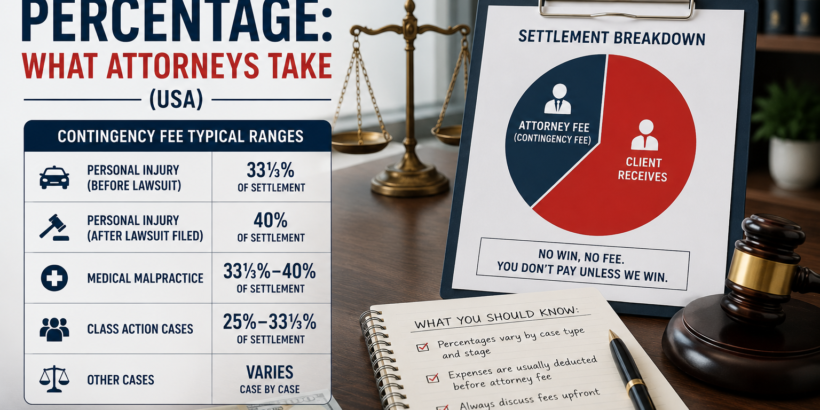
Most consumer legal guides describe contingency fees as running from one-third (about 33.3%) to 40% of the recovery. But the Federal Trade Commission states plainly that no standard national percentage exists. Your signed agreement and your state’s rules set the actual rate — and case costs, liens, and reimbursements then reduce what you personally receive.
That one-third-to-40% range has a real pedigree. The American Bar Association’s consumer guide to legal fees uses it to explain what injured clients commonly see, and individual firms explaining a typical lawyer’s percentage of settlement describe the same general pattern: roughly a third for an early resolution, stepping up toward 40% once litigation begins.
Treat the range as market guidance, not law. No federal statute fixes attorney percentages in injury cases, and the FTC’s guidance on hiring a lawyer is explicit that there is no officially standard amount. State rules can cap or restructure fees in particular case types — more on that below — but even then, the contract you sign, not a national norm, controls.
So is one-third or 40% “normal”? For a straightforward injury claim that settles, yes, those numbers sit inside the documented market. But normal answers the wrong question. The lawyer settlement percentage is only the first deduction in a series. A 33% fee followed by $6,000 in expert bills and a five-figure medical lien produces a very different result than 33% alone suggests. Each of those deductions has its own mechanics — starting with the fee contract itself.
What a Contingency Fee Is — and What It Is Not
A contingency fee is a legal fee paid out of a successful recovery instead of by the hour. No recovery, no attorney fee: the lawyer invests their time in your outcome rather than invoicing you monthly. Two terms anchor everything else in the agreement. Gross recovery is the full amount your case produces before any deduction. Net recovery is what remains after the fee, case costs, and third-party claims are paid — the number on your actual check.
This is the standard structure across American personal injury practice, and firms describe it openly because clients naturally ask. Cameron Law, a Nevada personal injury firm, is a typical example: it handles injury cases on a contingency basis, with no upfront attorney fee and the fee paid from whatever compensation is ultimately recovered. Regulator resources such as the State Bar of California’s fee and billing overview describe the same arrangement from the client’s side of the desk.
What a contingency fee is not: it is not the only deduction from your settlement. Three separate buckets draw from the money — the attorney’s percentage, the case costs (third-party expenses of building the claim), and claims by others, such as medical liens or insurer reimbursement rights. Blurring them together is how clients end up blindsided.
It is also not automatically free if you lose. “No fee” covers the lawyer’s time; it may not cover expenses. The FTC warns that clients can owe court costs and other expenses even after a loss, depending on the contract. Some firms absorb costs in a losing case; others bill them regardless of outcome; many recover them only from a successful result. Your signed agreement — not the billboard slogan — determines the loss scenario, which is why ABA Model Rule 1.5 requires contingency arrangements to be in writing and to spell out expense responsibility.
One comparison is worth making. Hourly billing charges for the lawyer’s time whether you win, lose, or settle for less than hoped, and usually demands a retainer up front. Contingency shifts that risk to the lawyer and opens the courthouse to people who could never finance a lawsuit. The trade-off: on a strong case that resolves quickly, the percentage can exceed what hourly fees would have totaled — one reason the rate is often negotiable.
How the Fee Is Calculated: Before Costs vs. After Costs
Here is the question that separates informed clients from surprised ones: is the percentage applied before case expenses come out, or after? Both methods appear in real contracts.
Fee before costs: gross recovery − percentage fee − costs = client net
Fee after costs: gross recovery − costs − percentage fee (on the remainder) = client net
The ABA’s fee guide illustrates the difference with a $12,000 recovery and $2,100 in costs. At a one-third fee taken before costs, the fee is $4,000 and the client nets $5,900. Taken after costs, the fee drops to $3,300 and the client keeps $6,600. Same case, same rate, same settlement — a $700 difference created purely by the order of operations.
Now scale it up. The following is a purely hypothetical $100,000 settlement with $6,000 in case costs and a one-third fee, shown both ways:
| Fee before costs | Fee after costs | |
|---|---|---|
| Gross recovery | $100,000 | $100,000 |
| Attorney’s fee (33⅓%) | $33,333 | $31,333 |
| Case costs | $6,000 | $6,000 |
| Client net | $60,667 | $62,667 |
The fee-after-costs column wins because the percentage is applied to a smaller base — $94,000 instead of $100,000. In this hypothetical the swing is $2,000 before any lien or tax question even enters the picture, and it grows with the case.
Which method applies to you is a contract term, not a universal rule. The written agreement should state plainly whether expenses come out before or after the fee is calculated; if yours doesn’t say, ask for the answer in writing before you sign. And notice what the table omits: medical liens, Medicare claims, and taxes. A realistic estimate of your take-home amount has to clear those hurdles too.
Why the Percentage Changes: Stage Triggers and Sliding Scales
If your contract says 33⅓% in one paragraph and 40% in another, that is usually deliberate design, not a typo. Contingency agreements change rates in two distinct ways, and confusing them costs clients money.
Stage-based increases. A claim that settles before a lawsuit is filed demands far less lawyer time and risk than one tried to a jury. Many agreements therefore quote one rate for a pre-suit resolution, a higher rate once a complaint is filed or an answer comes in, and sometimes a further step at trial or on appeal. The trigger definitions matter as much as the numbers: does the “trial rate” attach when a trial date is set, when the jury is picked, or at opening statements? Ask, and get the answer into the contract.
Bracket-based sliding scales. Other agreements tie the percentage to the size of the recovery — one rate on the first slice of money, a different rate on amounts above a threshold. The FTC notes that contingency-fee size can often be negotiated and specifically describes sliding-scale arrangements as a structure worth discussing before you sign. Florida’s professional rules, covered in detail in the next section, combine both mechanisms: the percentage responds to the stage of the case and, within a stage, to recovery tiers.
The two systems can pull in opposite directions. A declining bracket scale works in your favor, because the marginal dollar of a large recovery is charged at a lower rate than the first. A stage step-up almost never does — it raises the rate the moment litigation deepens.
Where does this leave the typical car accident settlement lawyer percentage? Exactly where every other personal injury case sits. Crash claims dominate the contingency market, but they use the same framework: a rate set by contract, often stepping up if suit is filed, sometimes tiered, always subject to state rules. No special national car-accident percentage exists, and anyone quoting a single “standard” number without asking about your case’s stage is simplifying. The same goes for verdicts: agreements generally apply the stated rate to any recovery, whether it arrives by settlement, verdict, or judgment — usually at the highest tier by then.
State Rules and Fee Caps: Labeled Examples, Not National Law
The examples below are state-specific. None of them is national law. State rules can cap, tier, or restructure contingency fees in ways that override any “common range” discussion.
Florida writes the structure directly into its professional-conduct rules. Under Rule 4-1.5 of the Rules Regulating the Florida Bar, a fee taken before an answer or arbitration demand is filed follows a tiered schedule: 33⅓% of any recovery up to $1 million, 30% of the portion between $1 million and $2 million, and 20% of the portion above $2 million. Later litigation stages carry different percentages, with special provisions for admitted-liability cases, appeals, and court-approved fees. Florida also requires a client-rights statement and gives the client three business days to cancel the signed contract.
California splits the topic into two statutes. Business and Professions Code § 6147 requires every contingency agreement to be in writing, to give the client a signed duplicate copy, and to state the agreed rate plus how costs will affect the fee and the client’s recovery; a noncompliant agreement is voidable at the plaintiff’s option, leaving the lawyer entitled only to a reasonable fee. Section 6146 separately limits fees in medical-malpractice cases — 25% for certain settlements reached before a complaint is filed and 33% once a complaint or arbitration demand exists, with a possible court-approved higher fee after trial or arbitration — and even defines the recovery as the net sum after qualifying disbursements and costs.
New Jersey regulates tort-case contingency fees through a court rule, Rule 1:21-7, built on a declining structure in which the permitted percentage steps down as the recovery grows — a legislated sliding scale rather than a single number.
Texas takes a transparency approach through Disciplinary Rule 1.04: written agreements must state the different percentages for settlement, trial, and appeal where they apply, explain how expenses are deducted, and describe the method of the final remittance, with a closing statement when the matter ends.
Medical malpractice deserves its own paragraph because caps like California’s can push a malpractice fee below the generic personal-injury range — blending the two into one “typical percentage” misstates both. If your claim involves a health-care provider, the one-third conversation may not apply to you at all. It is also worth knowing that no nationally representative “average lawyer contingency fee” statistic has been verified, so treat any single-number national average with skepticism.
Beyond the Percentage: Costs, Liens, Medicare, and Taxes
Case costs are the out-of-pocket expenses of building the claim, separate from the fee for the lawyer’s time. Common categories include:
- Court filing fees and service of process
- Deposition transcripts and court reporters
- Expert witnesses — accident reconstructionists, physicians, economists — often the largest single line item
- Medical-record retrieval charges
- Investigation, copying, postage, and travel
Your agreement should identify who advances these costs and what happens to them if you lose, which ties back to the loss scenario discussed earlier.
Third-party claims come next. If a health insurer, medical provider, or benefit plan paid for accident-related care, it may hold a legal right to repayment from your settlement — a medical lien in a provider’s case, or a subrogation or reimbursement claim in an insurer’s. These claims can sometimes be negotiated down, and whether your lawyer’s lien-resolution work is included in the quoted percentage is worth pinning down in writing. Third-party resolution is also why the final check can take weeks: liens and government claims generally must be confirmed before funds are disbursed.
Medicare adds a federal layer. CMS explains that Medicare can make “conditional payments” for accident-related care while another payer’s responsibility is worked out, and it seeks reimbursement once a settlement or judgment pays. Timing matters: after a Conditional Payment Notice, the recipient generally has 30 calendar days to respond, and CMS warns that failing to respond can produce a demand calculated without the usual proportional reduction. When the process is handled properly, CMS does account for reasonable procurement costs — meaning your attorney’s fee and expenses are factored into the recovery calculation rather than ignored. Medicare Advantage and Part D members may deal with the issuing plan instead, so coordinate early.
Finally, taxes — in qualified language, because the honest answer is “usually not, but not never.” IRS Publication 4345 explains that damages received on account of personal physical injuries or physical sickness are generally excluded from income, and that the actual treatment depends on the facts and circumstances, including how the settlement documents allocate the money. The exceptions bite: punitive damages are taxable, interest is taxable, damages for emotional distress that doesn’t flow from a physical injury can be taxable, and previously deducted medical expenses change the analysis. Anyone who promises every settlement is tax-free is oversimplifying — have the allocation reviewed before you sign the release.
Reading Your Agreement and Negotiating the Fee
Everything above converges on one document. Before signing, parse these six fields:
- The percentage — every rate, not just the headline one, including trial and appeal tiers.
- The recovery base — gross, or what remains after costs; even statutes define “recovered” differently, as California’s medical-malpractice rule shows.
- Stage triggers — the exact event (filing, answer, trial date, appeal notice) that moves the rate.
- Expense responsibility — who advances costs, and who owes them after a loss.
- Cost order — whether the fee is calculated before or after expenses, the $700 swing in the ABA example.
- The loss scenario — in plain words, what you owe if there is no recovery.
Can you negotiate? Often, yes — the FTC treats contingency fees as negotiable, and professional-guidance materials note that a lower pre-suit percentage can sometimes be agreed before work begins. A practical checklist of what to raise:
- Rate: the pre-suit and post-filing numbers, plus any trial step.
- Basis: gross versus net-of-costs as the fee foundation.
- Cost order: expenses deducted before or after the percentage.
- Loss scenario: zero-fee confirmation in writing.
- Lien work: whether negotiating medical liens is included in the fee or billed separately.
- Triggers: narrow, dated definitions of when each stage begins.
If your lawyer came through a referral, expect the fee to be divided with another firm — and expect disclosure. ABA Model Rule 1.5 generally requires client knowledge or written consent for fee sharing between lawyers in different firms, with a total fee that stays reasonable, and Texas Rule 1.04 imposes specific written-consent requirements. The important reader takeaway: a referral split comes out of the agreed fee. It should not stack a second percentage on top of yours.
At the end of the case, ask for — and actually read — the closing statement. Both the model rule and the Texas rule call for a written accounting showing the outcome and the method of calculation. Yours should list five things: gross recovery, the attorney’s fee, itemized case costs, third-party claims paid (liens, subrogation, Medicare), and your client net. If any line is vague, ask questions before endorsing the check.
Step-by-Step Agreement Review
- Locate the percentage rate. Find every number, including the trial and appellate tiers.
- Confirm the recovery base. Verify whether “recovery” means gross proceeds or the amount left after costs.
- Check stage triggers. Note the event that raises the rate and who decides when it has occurred.
- Identify expense responsibility. Confirm who advances costs and who repays them, in both the win and the loss columns.
- Verify the before/after-cost order. If the language is ambiguous, run one sample number both ways.
- Confirm the loss scenario. Get in writing what you owe if the case produces nothing; “no fee” paired with silence on costs is incomplete.
Conclusion: Estimate Your Net, Not Just the Percentage
The lawyer settlement percentage is the first number in the conversation, not the answer. No national standard exists; your signed agreement and your state’s rules control the rate; and your real outcome is the net recovery — what remains after the fee, case costs, medical liens, Medicare reimbursement, and any tax exposure each take their share.
So run the math before you sign. Ask the lawyer to show a sample distribution at plausible case values, using both the before-costs and after-costs formulas, and to point at the contract lines governing each deduction. When the case ends, request the itemized closing statement and compare it line by line, and verify your state’s rules with a licensed attorney.
A few quick answers readers ask most. Can a lawyer settle without your permission? No — accepting or rejecting an offer is your decision, and your lawyer must have your authorization. What if you lose? A true contingency agreement means no attorney fee, but the contract decides whether advanced expenses remain yours. What if you fire your lawyer? You generally can; the discharged lawyer may claim the reasonable value of work performed, usually resolved from any later recovery under your agreement and state law.
This article provides general legal information, not legal advice. Laws and procedures vary by jurisdiction; consult a licensed attorney about your specific situation.