
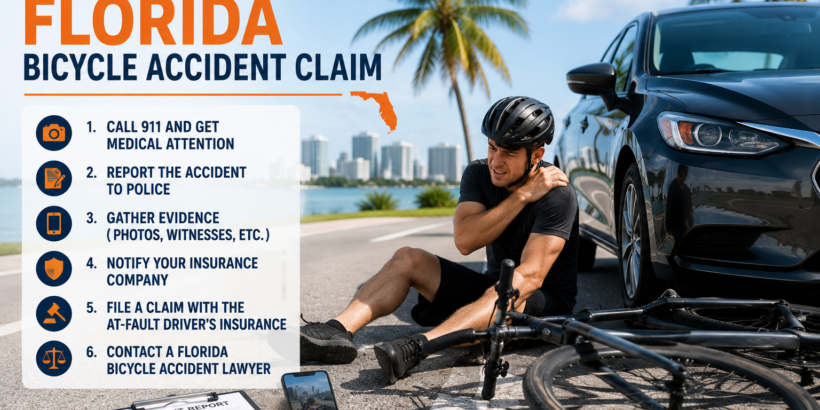
How to File a Florida Bicycle Accident Claim
Written and reviewed by Powellsss Editorial Team.
You’re lying on the asphalt at a Tampa intersection, your carbon frame snapped beneath a sedan’s bumper, and the driver is already insisting you “came out of nowhere.” Here’s what surprises most injured cyclists: the auto insurance system that pays your first medical bills probably isn’t the driver’s at all. Florida’s no-fault law can route your claim through your own car policy, a household relative’s coverage, or the vehicle owner’s insurer — in a specific statutory order. Filing a Florida bicycle accident claim correctly means understanding that order, protecting three separate deadlines, and documenting everything from the crash report to your cracked helmet. This guide walks through each stage.
To file a Florida bicycle accident claim, get medical care within 14 days to preserve PIP benefits, make sure law enforcement documents the crash, collect the driver’s insurance information, notify every potentially applicable auto insurer promptly, and keep detailed records of your injuries, expenses, lost income, and bicycle damage.
Immediate Steps After a Bicycle Accident in Florida
The first hours after a crash shape everything that follows. Insurers evaluate claims on paper, and the paper trail starts at the scene.
- Get safe, then get seen. Move out of traffic if you can, call 911, and accept evaluation by paramedics even if you feel “fine.” Adrenaline masks fractures, concussions, and internal injuries. Beyond your health, Florida’s PIP statute conditions medical benefits on receiving initial services and care within 14 days of the accident — a delay can cost you coverage entirely.
- Insist on a law-enforcement response. When a crash causes injury or at least $500 in apparent property damage, the driver must immediately notify police, the sheriff’s office, or the Florida Highway Patrol under Fla. Stat. §316.065. For qualifying injury crashes, the investigating officer prepares a long-form Florida Traffic Crash Report capturing the parties, witnesses, vehicle information, and insurer details under §316.066. That report becomes the spine of your claim file.
- Exchange information. Get the driver’s name, license number, plate, and insurance carrier, plus contact details for every witness. Note the responding agency and the report number.
- Notify insurers promptly. Florida’s Department of Financial Services auto-claim guidance recommends quick notice, careful documentation, and a review of your policy’s duties. That may mean contacting your own auto insurer, a resident relative’s carrier, and the vehicle owner’s insurer — not just “the other driver’s company.” If you want a second perspective on the notification sequence, this firm’s walkthrough of a Florida bicycle accident insurance claim covers similar ground.
- Hold off on recorded statements and releases. You’re generally required to cooperate with your own insurer, but you don’t have to give the at-fault driver’s adjuster a recorded statement on day one, and you shouldn’t sign a medical authorization or settlement release before you understand your injuries.
To obtain the official crash report, request it from the investigating agency or through the state crash-record system — the Florida Department of Transportation identifies FLHSMV as the custodian and points users to FloridaCrashPortal.gov. Be aware that reports containing personal information carry a statutory 60-day confidentiality period with limited access.
Preserving Physical and Electronic Evidence at the Scene
Photograph vehicle positions, your bicycle’s resting place, sightlines, debris fields, skid marks, and lighting conditions before anything moves. Save your cycling computer and phone GPS data, which can establish speed and position. Keep the damaged helmet, torn kit, and broken components exactly as they are — don’t repair the bike or discard anything until the property claim resolves. Insurers and juries believe objects more than recollections.
Which Insurance Pays First? The Florida Coverage Priority Tree
The most persistent myth in Florida bike cases is that the driver’s insurance pays right away. It usually doesn’t. Florida’s Motor Vehicle No-Fault Law makes Personal Injury Protection the first layer, and §627.736 can extend PIP to the named insured, qualifying resident relatives, vehicle occupants, and certain people struck by the insured motor vehicle while outside a self-propelled vehicle. Which policy applies to you depends on your household and the crash facts.
If you own a car, start with your own auto policy. If you don’t, look to a qualifying resident relative’s policy — §627.732(6) defines that term around relatives who usually make their home in the same family unit. Only when neither source exists do certain out-of-vehicle provisions route the claim to the insurer of the vehicle’s owner — and note the statute says the owner’s insurer, not necessarily the driver’s, a distinction that matters when the driver borrowed the car.
Coverage Hierarchy for Injured Bicyclists
A practical priority order looks like this: (1) your own auto PIP; (2) a resident relative’s auto PIP; (3) the striking vehicle owner’s PIP, but only when the statutory conditions are met; (4) the at-fault party’s bodily-injury liability coverage for losses beyond PIP; and (5) UM/UIM, MedPay, or health insurance for remaining gaps. Each step is fact-specific — policy language, residency, and ownership all matter.
Once first-party benefits are exhausted or inapplicable, the claim shifts to fault-based recovery: bodily-injury liability claims against the driver or owner, then uninsured or underinsured motorist coverage when the responsible party lacks adequate insurance. Medical bills during this process follow their own track, covered below.
Understanding Florida PIP Coverage for Cyclists
Personal Injury Protection is the engine of early payment in a Florida PIP coverage bicycle accident scenario. Under §627.736(1), required PIP provides up to $10,000 in combined medical and disability benefits plus $5,000 in death benefits — but that $10,000 is a ceiling, not a promise, and several gates stand between you and the full amount.
First, PIP pays 80 percent of reasonable, medically necessary medical expenses, and only when initial care happens within 14 days. Second, the emergency-medical-condition determination controls how much of the ceiling you can actually reach. Third, PIP disability benefits pay 60 percent of lost gross income or earning capacity plus certain household-service replacement costs — partial wage replacement, not full salary.
| Feature | PIP | Bodily-Injury (BI) Liability | UM/UIM |
|---|---|---|---|
| Whose policy | Yours, a resident relative’s, or the vehicle owner’s (statutory order) | The at-fault driver’s or owner’s | Yours or a resident relative’s |
| Fault required? | No — pays regardless of fault | Yes — must prove legal responsibility | Yes — plus uninsured/underinsured status |
| Typical benefits | 80% medical, 60% wage loss, $5,000 death benefit | Full economic damages; non-economic damages if threshold met | Damages the at-fault party’s insurance should have covered |
| Limit structure | $10,000 combined medical/disability; $2,500 cap without an EMC | Policy limits chosen by the insured | Your selected limits; included unless rejected in writing |
| Pain and suffering | Never | Only if the tort threshold is met | Follows the same threshold analysis |
Florida auto policies generally include UM coverage unless the named insured rejects it or picks lower limits in writing under §627.727(1), so pull the declarations page early — it’s evidence, not paperwork.
The 14-Day Initial Treatment Rule and Emergency Medical Condition (EMC) Limits
Miss the 14-day window for initial services and care, and PIP medical benefits are off the table under §627.736(1)(a). Within the window, the emergency-medical-condition finding sets your ceiling: an authorized provider’s EMC determination supports benefits up to $10,000, while a finding of no EMC caps medical benefits at $2,500. The EMC definition in §627.732(16) turns on acute symptoms with a reasonable risk of serious jeopardy, impairment, or dysfunction.
Physical Contact Rules vs. No-Contact Swerve Accidents
Several out-of-vehicle PIP provisions expressly require physical contact with a motor vehicle. If a car ran you off the road and you crashed without impact, don’t assume PIP applies — that’s a fact question, not a guaranteed outcome. The stronger routes in a no-contact swerve or phantom-vehicle crash are a negligence claim against an identified driver and a UM claim when the vehicle fled or can’t be found. Preserve any witness accounts and camera footage; they become the whole case.
Filing Third-Party Bodily-Injury and UM/UIM Claims
PIP rarely covers a serious bicycle crash injury claim in Florida by itself. When medical costs, lost income, and human losses exceed first-party benefits, the claim moves against the people who caused the crash.
A bodily-injury liability claim targets the at-fault driver’s — and sometimes the vehicle owner’s — liability coverage. Florida’s tort threshold in §627.737(2) gates non-economic damages: to recover for pain, suffering, and similar losses against a motor-vehicle owner, registrant, or operator, you generally need a qualifying significant or permanent injury, significant permanent scarring or disfigurement, or death. Economic damages like medical bills and lost wages aren’t blocked by that threshold.
When the driver carries no insurance, flees the scene, or holds limits too small for your losses, UM/UIM coverage steps in. A bicycle accident settlement in Florida often layers these sources: PIP first, BI liability second, UIM for the remainder. Build the claim like a file, not a phone call — crash report, medical records and bills, wage documentation, policy declarations, and a written demand that ties liability evidence to each damage category. If injuries are serious, fault is disputed, or multiple policies overlap, consulting a Florida bicycle accident lawyer before you negotiate can prevent expensive mistakes.
Navigating UM/UIM Settlement Notices and Release Traps
Here’s a trap that quietly destroys valid claims: settling with the at-fault driver’s insurer before protecting your UIM rights. §627.727(6) imposes written-notice and insurer-response procedures before you accept a liability settlement that may create an underinsured-motorist claim. Sign the wrong release first, and your own UIM carrier may owe you nothing. Review the policy and get claim-specific advice before executing any release.
Managing Medical Bills, Wage Loss, and Health Insurance Coordination
Treatment doesn’t pause while adjusters argue. So who pays bike accident medical bills in Florida while the claim is pending? In order, roughly: PIP first, then MedPay if purchased, then health insurance, with the liability settlement settling accounts at the end.
PIP is generally primary over other insurance and payable as losses accrue upon reasonable proof under §627.736(4). It reimburses 80 percent of covered medical charges and 60 percent of lost gross income — leaving a 20-percent medical gap and 40-percent wage gap that someone must absorb in the interim. Medical Payments coverage, where the policy includes it, is secondary to PIP and can close part of that gap, as the state’s official PIP rights form OIR-B1-1149 explains in plain language.
Two practical rules keep the money flowing. Give every provider the correct auto-insurer claim information immediately, because PIP billing statements generally can’t include services rendered more than 35 days before submission (a timely notice of initiation can extend that to 75 days in specified circumstances) under §627.736(5)(c). And expect health-insurance coordination: when your health plan pays accident-related charges, it may assert subrogation or reimbursement rights against your eventual settlement. Track every explanation of benefits — those reimbursement claims are negotiable line items at resolution, not surprises to discover afterward.
Florida Fault Laws and Evidence Requirements in Bike Accidents
Florida fault laws in bicycle accidents run on modified comparative fault. Under §768.81, your damages shrink in proportion to your share of responsibility — and if your share exceeds 50 percent in a covered negligence action, recovery is barred entirely. Every piece of evidence either moves that percentage or it doesn’t matter.
Florida’s cycling statutes supply the measuring stick. §316.083 requires a motorist passing a bicycle to allow at least three feet of clearance or wait until passing is safe. §316.2065 governs the cyclist’s side: riders traveling below normal traffic speed generally use a bike lane or ride as close as practicable to the right edge, but the statute lists real exceptions — passing, preparing a left turn, avoiding hazards, and lanes too narrow to share. Sidewalk riding isn’t categorically banned statewide; a cyclist on a sidewalk or crosswalk holds the rights and duties of a pedestrian, must yield to pedestrians, and must give an audible signal before passing one, though local ordinances deserve a separate check.
One protection deserves emphasis: under §316.2065(18), failure to wear a helmet may not be considered evidence of negligence or contributory negligence in a civil action. An adjuster implying otherwise is wrong on the law.
Organize your evidence by what it proves: the crash report establishes the event, parties, and insurers; scene photos establish roadway conditions and sightlines; the damaged bicycle and gear establish impact force; medical records establish causation and prognosis; wage records establish income loss; and your communications log establishes notice, requests, and denials.
Modified Comparative Fault (50% Bar Rule) in Negligence Claims
The math is unforgiving. At 20 percent fault, a $100,000 verdict becomes $80,000. At 51 percent fault, it becomes zero. Because insurers know this, expect fault arguments framed around lane position, lighting, and right-of-way — which is exactly why the statutory exceptions and evidence matrix above matter more than the police report’s initial impressions.
Claiming Damage to Bicycles, Helmets, and Cycling Gear
Property damage runs on a separate track from bodily injury, with its own proof and its own negotiation. A race bike with a custom frame, carbon wheelset, power meter, and electronic shifting can exceed the value of the car that hit it — but only if you document it.
Build an itemized inventory: the frame and fork, each component group, wheels, saddle and cockpit, helmet, cycling kit and shoes, lights, sensors, and the bike computer. Attach purchase receipts where you have them, current replacement prices where you don’t, and pre-crash photos showing condition. Keep every damaged item; an adjuster’s inspection is standard, and disposing of the frame early invites a lowball offer.
Valuation is a negotiation, not a formula. Insurers may argue depreciation; your counter is replacement cost for equivalent equipment, supported by current retail listings. The state’s aforementioned auto-claim guidance and the Florida Bar’s automobile insurance consumer pamphlet both walk through documenting damage and negotiating with adjusters. One caution: don’t let quick property settlement paperwork sweep in a bodily-injury release. Read every line — the property check and the injury claim should stay legally separate.
Deadlines, Claim Escalation, and When to Consult a Lawyer
Florida runs three clocks at once, and confusing them is how valid claims die. The 14-day rule governs initial care for PIP eligibility. Separately, PIP benefits can become overdue if unpaid within 30 days after proper written notice of the covered loss and amount under §627.736(4)(b). And a negligence lawsuit generally carries a two-year limitations period under §95.11(4)(a). A claim is a demand to an insurer; a lawsuit is a court filing — settling the first never requires filing the second, but missing the limitations date ends your leverage permanently.
If an insurer stalls or underpays, escalate in writing: request the denial basis and itemization, keep a communications log, and remember that the Florida Department of Financial Services can assist with certain insurance concerns but cannot give legal advice, decide fault, or value your claim. When injuries are serious, fault is contested, or UM/UIM and release issues stack up, experienced Florida counsel — firms such as Zervos & Calta, PLLC, which handles injury claims across the Tampa Bay region — can evaluate the coverage order and deadlines before they close.
Three takeaways carry the most weight: find the right PIP policy before assuming the driver pays; treat the 14-day, 30-day, and two-year clocks as separate deadlines; and never sign a release before your UM/UIM position is safe. Your next step is simple — pull your auto policy’s declarations page today and confirm exactly which coverages you already own.
This article provides general legal information, not legal advice. Laws and procedures vary by jurisdiction; consult a licensed attorney about your specific situation.