
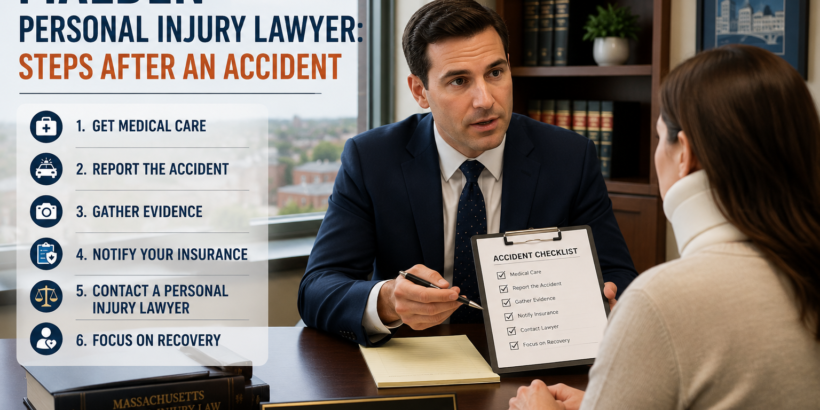
Malden Personal Injury Lawyer: Steps After an Accident
Written and reviewed by Powellsss Editorial Team.
The minutes after a crash on the Fellsway or a fall outside a Malden Square storefront rarely feel orderly. Adrenaline masks pain, phones come out, and almost nobody is thinking about the Registry of Motor Vehicles. Yet Massachusetts law gives many drivers just five days to file a written crash report, and other deadlines—some as short as thirty days—start running immediately. Miss one, and an otherwise strong claim can collapse before it begins.
Below is a practical walkthrough of the steps after an accident in Malden, in roughly the order you’ll face them: emergency care, reporting, insurance, fault rules, special claim types, and the deadlines that control everything.
Immediately check for injuries, call 911, and move to safety. Seek prompt medical evaluation even for minor symptoms. At the scene, document the evidence with photos, get witness details, and exchange driver and insurance information. Notify your insurer promptly—sticking to facts and avoiding speculation about fault—and then calendar the strict reporting deadlines covered below.
Immediate Steps to Take After an Accident in Malden
Start with safety. Call 911, and if the vehicles are drivable and anyone might be hurt, move out of traffic. Yes, call even after what looks like a minor collision: symptoms emerge later, and an officer’s record anchors the basic facts while memories are fresh. Accept evaluation by EMTs, and if you decline transport, get examined the same day. Gaps between the accident date and first treatment are among the first things insurers use to discount personal injury claims in Massachusetts.
While you’re at the scene, collect more than you think you need. Photograph vehicle positions before anything is moved, damage close-up and wide, license plates, traffic signals, skid marks, weather, and any visible injuries. Exchange license, registration, and insurance details with every driver, and get witness names and phone numbers before people drift away.
A working evidence checklist:
- Photos and video of the scene, vehicles, plates, signals, and road conditions
- Names and contact information for witnesses
- The other driver’s license, registration, insurer, and policy number
- The responding agency’s name and the officer’s report or incident number
- Same-day medical records, discharge papers, and receipts
- Every insurance letter, email, and claim number that follows
Notify your own insurer promptly. The Massachusetts Division of Insurance recommends quick reporting backed by photographs, participant and witness information, and accurate facts. Give facts, not theories—don’t estimate your speed, apologize, or say you’re “fine” before anyone has examined you.
Medical Red Flags and Delayed Symptoms
Concussion symptoms don’t always show up at the scene. CDC guidance notes they can appear hours or days after a head impact—headache, fogginess, nausea, light sensitivity, mood or sleep changes. Some signs demand emergency care: a worsening headache, repeated vomiting, slurred speech, unusual drowsiness, unequal pupils, or convulsions. When in doubt, go to the emergency room and say you were in a crash.
Reporting the Crash: Police Reports vs. RMV Operator Reports
Massachusetts runs a “two reports, two clocks” system that confuses nearly everyone. The first report belongs to the police: the responding or investigating officer generates an official crash report. You don’t file that document—you request copies of it later. The second report is yours. Under M.G.L. c. 90, § 26, any operator involved in a crash causing death, injury, or more than $1,000 in damage to any one vehicle or piece of property must file a written Motor Vehicle Crash Operator Report within five days. While the statute has exceptions for physical incapacity, you should assume the duty to report is yours until your attorney confirms otherwise.
Two clarifications matter. Calling your insurance company is not a crash report. And the officer taking notes at the scene doesn’t satisfy your obligation—if the statutory triggers are met, you file your own form. Given modern vehicle repair costs, even a minor fender bender clears the $1,000 threshold easily. To protect your claim, you should treat nearly any crash as reportable.
The submission process, per Mass.gov’s crash-report instructions:
- Get the current Massachusetts Motor Vehicle Crash Operator Report form from Mass.gov.
- Complete it carefully, sticking to observable facts.
- Send copies to three places: the RMV, the police department with jurisdiction over the crash location, and your insurance company.
- Keep a copy plus proof of submission—certified mail receipts or confirmation screenshots work. Note that there is no filing fee for this submission.
Local Routing: Malden Police vs. State Police Jurisdiction
Where the police copy goes depends on where the crash happened. The City of Malden’s crash-report resources explain that Malden Police handle crashes they investigate on city streets, while crashes on state roadways—Route 1 and the Fellsway are the usual examples—route to the Massachusetts State Police. If you’re unsure which agency responded, ask the officer at the scene or confirm with the city before mailing.
Requesting Official Crash Records
The RMV asks that you wait at least four weeks before requesting a processed police crash report. Requests carry a $20 non-refundable search fee, and paying it doesn’t guarantee a report will be found—Mass.gov’s request page covers eligibility and procedure. Your insurer or attorney can often obtain the same record.
Understanding Massachusetts No-Fault PIP and Medical Payments
Massachusetts is a no-fault auto-insurance state, which means the first question after a crash isn’t “who caused it?”—it’s “whose PIP pays?” Personal Injury Protection is first-party coverage defined by M.G.L. c. 90, § 34A. Regardless of fault, PIP pays specified reasonable and necessary medical expenses, up to 75% of lost wages, and replacement services—help with household tasks you can’t perform while injured—subject to a statutory limit of at least $8,000 per injured person.
In most Malden crashes, your own auto policy’s PIP responds first, even if the other driver ran the light. Passengers and pedestrians are generally covered under the applicable vehicle’s policy, and deductibles, policy terms, and workers’ compensation can shift the analysis.
Payment coordination trips people up. Per the Division of Insurance’s coordination-of-benefits guidance, when you have private health insurance, PIP generally covers the first $2,000 of accident-related medical bills; after that, providers bill your health plan, and PIP can pick up eligible amounts the health plan doesn’t pay, up to the $8,000 limit. Optional Medical Payments (MedPay) coverage can fill remaining gaps. The practical move: tell every provider the visit is accident-related, ask which payer should receive the bill, and keep every explanation of benefits.
PIP also comes with duties. Under M.G.L. c. 90, § 34M, a PIP claim must be presented as soon as practicable and, in every case, within at least two years of the accident, with information about your injuries, treatment, and wage loss. The statute lets insurers require reasonable medical examinations, and noncooperation can become a defense if you later sue over PIP benefits. Respond to legitimate requests, attend scheduled exams, and keep wage authorizations and records organized.
What PIP doesn’t pay is just as important: it provides nothing for pain and suffering, nothing for the other driver’s vehicle damage, and nothing beyond its $8,000 limit. Those gaps point to the third-party system.
Pursuing a Third-Party Claim: The $2,000 Threshold and Fault Rules
A third-party claim runs against the at-fault driver’s liability coverage or assets. It can include economic damages—medical costs beyond PIP, diminished earning capacity—and non-economic damages such as pain and suffering. Property damage, including repair and diminished-value disputes, is a separate policy-specific track from bodily injury.
Massachusetts gates pain-and-suffering recovery in motor-vehicle cases. Under M.G.L. c. 231, § 6D, you cannot recover for pain and suffering in a motor-vehicle tort action unless your reasonable and necessary medical expenses exceed $2,000—or a statutory exception applies: death, loss of a body member, permanent and serious disfigurement, qualifying loss of sight or hearing, or a fracture. Two mistakes are common: treating $2,000 as a filing deadline (it’s a damages threshold, not a clock), and assuming it blocks all recovery (economic losses and the exceptions stand apart).
Fault shapes everything else. M.G.L. c. 231, § 85 applies modified comparative negligence: your damages shrink in proportion to your share of negligence, and recovery is barred only if your negligence is greater than the negligence of the parties you sued—effectively a 51% cutoff. If a jury values a case at $100,000 and assigns you 20% of the fault, the award becomes $80,000. The law places the burden of proving your negligence on the opposing party, which is a primary reason to avoid casual admissions at the scene or on the phone. Before giving a recorded statement to the other driver’s insurer, understand what fault theory they’re building; a request for “your side of the story” is often a search for concessions.
These are the same evaluation frameworks any Malden personal injury attorney applies before valuing a claim. Reviewing local practice resources—such as how Malden, MA Personal Injury Lawyers summarize comparative negligence, damage categories, and state filing deadlines—can help you organize your questions before your first adjuster call.
Overview of Auto Insurance Liability Minimums
For policies issued or renewed on or after July 1, 2025, the Division of Insurance’s Consumer Bill of Rights lists minimums of $25,000 per person and $50,000 per accident for bodily injury to others, 25, 000/50,000 for uninsured motorists, and $30,000 for damage to someone else’s property, with PIP unchanged at $8,000 per person. Check the policy date—older minimums still circulate online, and many drivers carry more.
Special Injury Claims: Premises Falls, Hit-and-Runs, and Rental Cars
Not every Malden injury follows the car-crash template. A fall in a grocery aisle, a trip on a heaved sidewalk, a hit-and-run on Salem Street, or a collision in a rented SUV each follows different rules. Public-way defects—broken sidewalks, potholes—fall under M.G.L. c. 84, § 18, which requires written notice within 30 days to whoever is legally responsible for keeping the way in repair. A Malden slip and fall lawyer will usually start by identifying who controlled the property, because that answer determines which notice clock applies.
| Scenario | Governing rule | Critical notice or deadline | Likely payment source |
|---|---|---|---|
| Private-property slip and fall | General premises negligence | Three-year limitations period | Owner’s liability insurance |
| Defective public way | M.G.L. c. 84, § 18 | Written notice within 30 days to the responsible entity | City, town, or party responsible for repair |
| Snow-and-ice fall | M.G.L. c. 84, § 21 | 30-day written notice with specific service rules | Property owner or party controlling the premises |
| Uninsured or hit-and-run driver | M.G.L. c. 175, § 113L | Prompt police report and policy notice | Your uninsured-motorist coverage |
| Rental or leased vehicle crash | Acts of 2025, Chapter 78 | Policy and rental-agreement terms | Renter’s policy and any rental coverage—fact-specific |
For hit-and-runs and uninsured drivers, § 113L requires uninsured-motorist protection for people legally entitled to recover from those motorists, subject to policy terms and proof requirements. Report the crash to police immediately; Massachusetts hit-and-run injury claims almost always depend on it, and delay hands insurers arguments.
Rental vehicles changed recently. Acts of 2025, Chapter 78 amended the rental and leased-vehicle provisions of §§ 32E and 34M, effective February 24, 2026. Which policy responds—yours, the rental company’s coverage, or another driver’s—now depends on the rental agreement, driver status, and the vehicle’s status, so don’t assume the old rules apply.
Snow and Ice Notice Requirements
Winter falls deserve special urgency. M.G.L. c. 84, § 21 extends the public-way notice framework to injuries from snow or ice on private premises or adjoining ways: written notice within 30 days, with specific service requirements and rules about whether late notice prejudiced the property owner. Photograph the condition before it melts, identify who controlled the premises, and treat 30 days as the ceiling, not the target.
Massachusetts Personal Injury Deadlines and Presentment Requirements
The general rule is three years. M.G.L. c. 260, § 2A requires tort actions—including most injury claims—to be filed within three years after the cause of action accrues. Accrual usually means the accident date, but it isn’t always identical; injuries discovered later raise questions that need legal review, not guesswork. Treat three years as the outer limit and build the case long before it.
Claims against public employers run on a second track. If a Malden sidewalk defect, a city vehicle, an MBTA bus, or a state facility contributed to your injury, M.G.L. c. 258, § 4 generally requires written presentment of the claim to the public employer’s executive officer within two years, and bars suit until presentment is resolved or deemed denied. The civil action itself still can’t be brought more than three years after accrual. Presentment is a formal written delivery, not a phone call to city hall—and it’s separate from the 30-day defective-way notice described above. Both clocks can run on the same facts.
Deadlines are unforgiving partly because evidence isn’t: storefront video gets overwritten, witnesses move, and the 30-day notices expire before many people have hired anyone. The working timeline:
- Immediately: medical care, 911, and scene documentation
- Within five days: the RMV operator crash report for qualifying crashes
- Within 30 days: written notice for public-way defects and snow-or-ice injuries
- As soon as practicable, and within at least two years: the PIP claim; within two years for public-employer presentment
- Within three years: most personal-injury lawsuits
If litigation becomes necessary, local geography matters. Malden District Court, at 4040 Mystic Valley Parkway in Medford, serves Malden, Melrose, Everett, and Wakefield. Where a given case belongs depends on the amount at issue and the parties—not every injury suit lands there—but most Malden residents will encounter that courthouse at some stage. Because exceptions can shorten or extend every deadline above, filing injury claims in Malden, MA safely means confirming dates with counsel rather than trusting memory.
Navigating the Settlement Process and Working with Counsel
Most claims follow the same arc: treat until your condition stabilizes, assemble records, bills, and wage documentation, present a demand package, negotiate, and litigate only if negotiation stalls. How long a personal injury settlement in Malden takes depends on treatment length and dispute complexity. The Division of Insurance sets no fixed settlement deadline, though insurers must pay claims within a prompt and reasonable time. Be wary of early offers: signing a release ends the claim, including symptoms that haven’t surfaced yet.
When you hire a lawyer, expect a contingency arrangement. SJC Rule 1.5 requires a written agreement, signed in duplicate, stating the contingency, the percentage or calculation method, and how expenses are handled. Ask about the percentage, litigation costs, scope of representation, and what happens if representation ends early—there is no universal rate.
Legal review matters most when fault is disputed, injuries are serious or permanent, a public entity or uninsured driver is involved, or a release is on the table. Established Massachusetts injury practices such as the Law Office of John J Sheehan evaluate precisely these decision points before advising whether an offer reflects a claim’s full value.
Conclusion: Protecting Your Rights After a Malden Accident
Three priorities carry everything else. First, protect your health and document it: same-day medical care and disciplined evidence collection give every later step credibility. Second, respect the clocks—the five-day RMV operator report under M.G.L. c. 90, § 26, the 30-day notices, two-year presentment, and the three-year lawsuit window. Third, keep the insurance layers straight: PIP pays first regardless of fault, while a third-party claim—gated by the $2,000 threshold and comparative-fault rules—addresses what PIP never covers.
Your next step is simple: gather your photos, report numbers, and medical records into one folder, calendar the deadlines that apply to your facts, and—if your injuries are anything beyond minor—consult a Malden personal injury lawyer before signing anything.
This article provides general legal information, not legal advice. Laws and procedures vary by jurisdiction; consult a licensed attorney about your specific situation.