
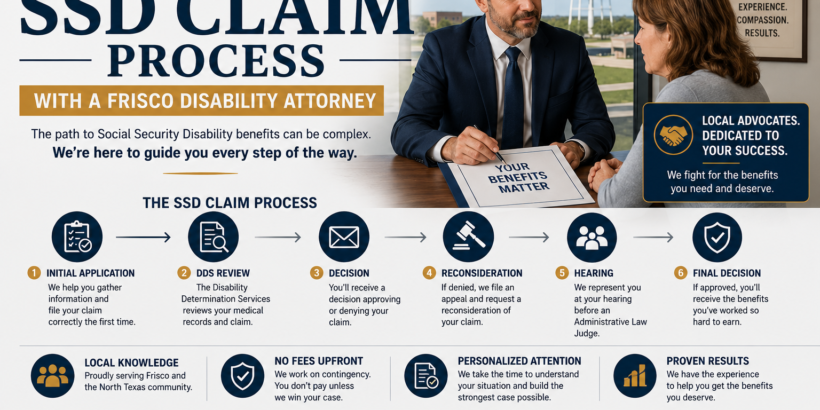
Navigating the SSD Claim Process With a Frisco Disability Attorney
Written and reviewed by Powellsss Editorial Team.
Maria spent eleven years loading trucks at a distribution center off the Dallas North Tollway before her degenerative disc disease made that impossible. She filed for disability on her own, assumed her MRI would speak for itself, and opened a denial letter seven months later. The letter gave her 60 days to respond—and she wasn’t sure 60 days from when. Her situation is common in Frisco, where a growing workforce means a growing number of people suddenly unable to work. The SSD claim process is long, technical, and unforgiving of missed deadlines, but it follows a predictable 5-stage administrative chain. Understanding your exact stage and deadline is the single most effective way to protect your retroactive benefits.
The SSD Claim Process at a Glance
The SSD claim process runs application → SSA field-office review → state DDS medical determination → written decision → reconsideration → ALJ hearing → Appeals Council → federal court. A Frisco disability attorney is optional at every stage but most valuable after a denial, where deadlines and evidence strategy decide the case.
Here’s how to locate yourself in that chain. You file an application, and your local SSA field office (Frisco claimants are served primarily by the McKinney field office) verifies nonmedical eligibility—work credits, income, identity. The file then moves to Texas’s Disability Determination Services (DDS), which gathers medical evidence and issues the initial written decision. If you’re denied, you request reconsideration, then a hearing before an administrative law judge (ALJ), then Appeals Council review, and finally federal district court. Each level is separate, with its own deadline. The full framework appears in SSA’s appeals process overview.
Three decision points matter most:
- Complete filing — a thorough initial application with functional evidence shortens everything downstream.
- Timely appeal — the 60-day clock after a denial is unforgiving.
- Hearing-stage representation — the ALJ hearing is where preparation and expert testimony most often decide the outcome.
People searching for Social Security disability benefits in Frisco often encounter outdated numbers, so here are the current ones:
2026 figures at a glance
- SGA limit: 1, 690/month * * (nonblind)/ * *2,830/month (blind)
- SSDI waiting period: five months before the first benefit month
- Retroactive benefits: up to 12 months before your application date
- Representative fee cap: $9,200 under fee agreements
SSDI, SSI, or Both? Understanding Social Security Disability Eligibility
“SSD” is shorthand that blurs two distinct programs, and Social Security disability eligibility depends on which one fits you. SSDI is insurance: you earn work credits by paying Social Security taxes, and those credits establish insured status. SSI is needs-based, for people with little income and resources who are disabled, blind, or 65 or older; the general resource limits are $2,000 for an individual and $3,000 for a couple, per SSA’s SSI eligibility rules. Concurrent claims—applying for both—are possible and common when someone has some work history but low expected benefits.
One widespread oversimplification deserves correction: “you must have worked five of the last ten years” is not a universal rule. According to SSA’s disability eligibility page, older workers generally need 40 credits with 20 earned in the last 10 years, but younger workers may qualify with fewer credits. Your exact insured status depends on your age and alleged onset date.
Both programs use the same adult medical standard. Under 20 CFR §404.1505, disability means you can’t engage in substantial gainful activity because of a medically determinable impairment expected to last at least 12 months or result in death. SSA applies a five-step evaluation, which in plain English asks:
- Are you working above the SGA level now?
- Is your impairment severe?
- Does it meet or equal a listed impairment?
- Can you still do your past work?
- Can you do any other work that exists in significant numbers?
Can you work while applying? Possibly, but earnings above the SGA threshold generally undermine the claim at step one.
Comparison table — SSDI vs. SSI at a glance
| Factor | SSDI | SSI |
|---|---|---|
| Work credits | Required; amount varies by age | Not required |
| Income/resource limits | No resource limit; SGA earnings cap | $2,000 individual / $3,000 couple resources |
| Waiting period | Five months before first benefit | No waiting period; payment tied to eligibility month |
| Health coverage trigger | Medicare after 24 months of SSDI entitlement | Medicaid, often immediately upon eligibility |
| Best fit | Workers with sufficient recent work history | Low-income individuals with limited work history |
How to Apply for SSDI in Texas: The Application Stage
You can file online, by phone, in person at a field office, or by mail. Whichever route you choose, the SSD claim application process splits between two agencies. The SSA field office confirms nonmedical eligibility—your insured status, age, and current work activity. Then the file goes to Texas Disability Determination Services (DDS), operating under Texas HHSC, where examiners develop the medical evidence and make the actual disability determination, as explained in SSA’s disability determination process.
DDS requests records from your own treating sources first. It orders a consultative examination only when the available evidence is insufficient—so a complete provider list at filing directly affects how your claim develops. The SSA adult disability application checklist asks for the date your condition began affecting work, recent job history, medical sources, treatment dates, medications, and tests.
How long does an initial decision take? SSA’s timing FAQ estimates six to eight months, varying with medical evidence, examinations, and quality review. That’s a national estimate—no one can honestly promise a Frisco-specific timeline.
Step-by-step list — preparing your application
- Confirm insured status and onset date. Check your Social Security earnings record before filing.
- Gather a complete provider list with names, addresses, and treatment dates.
- Document your 15-year work history, including job duties and physical demands.
- Describe functional limits, not just diagnoses—how long you can sit, stand, lift, concentrate.
- File through your chosen route and keep copies of everything.
- Respond promptly to DDS requests for forms, records, or examinations.
Medical Evidence That Wins: Function Over Diagnosis
A diagnosis alone doesn’t win a claim. Under SSA’s Blue Book general information, your own statement about symptoms doesn’t establish a medically determinable impairment—clinical and laboratory evidence must. An MRI report matters; a note saying “patient reports back pain” does not, by itself.
The claims that succeed translate medical findings into work-function terms. DDS and ALJs want to know: How long can you sit, stand, and walk? How much can you lift? Can you maintain concentration and pace through a workday? How’s your attendance when symptoms flare? What side effects do your medications cause? How often do symptoms occur, and how long do they last? That translation is your residual functional capacity (RFC)—what you can still do despite your limitations.
Your condition doesn’t have to appear in the Blue Book. A condition can meet a listing, medically equal one in severity, or—most commonly—produce an RFC so limiting that no work is possible at steps four and five. Several conditions can also combine: moderate depression plus chronic pain plus medication fatigue may be individually manageable but collectively disabling.
Cost shouldn’t block your evidence. Texas Health and Safety Code §161.202 generally bars providers from charging you for records requested to support a Title II or Title XVI disability application or appeal, subject to the statute’s conditions. A simple request script:
“I’m requesting my complete medical records to support my pending Social Security disability application/appeal under Texas Health and Safety Code §161.202. Attached is documentation of my pending claim. Please advise if you need anything further.”
Attach a copy of your application confirmation or denial notice so the request documents the pending claim.
After a Denial: The SSD Claim Denial Appeal and the 60-Day Clock
Most initial claims are denied, so treat the first decision as a stage, not a verdict. The SSD claim denial appeal path has four levels: reconsideration, ALJ hearing, Appeals Council review, and federal district court.
The deadline math trips people up. You generally have 60 days after receipt of the notice, and SSA presumes you received it five days after the printed date unless you show otherwise. So a notice dated March 1 functionally allows until roughly May 5—about 65 days from the printed date (or the next business day if the deadline falls on a weekend or federal holiday). That’s planning shorthand, not the rule; your notice’s instructions control.
What does reconsideration change? According to SSA’s reconsideration page, a different DDS examiner reviews your file. Repeating the same evidence usually repeats the same result. Instead, address the denial’s stated reasons directly, update your treatment and work information, and submit new evidence—recent imaging, a treating physician’s RFC opinion, records from visits since you applied. You can file online or submit Form SSA-561.
Should you appeal or reapply? Appeal. Filing a new application abandons your existing claim, sacrifices your protective filing date and potential back pay, and likely produces the same denial with the same evidence. Preserving the appeal route preserves your onset date. If you’ve already missed the deadline, good-cause exceptions exist, but they’re discretionary—don’t rely on them.
The ALJ Hearing: How a Disability Attorney Prepares Your Case
The hearing is where most successful claims are won, and it’s where preparation pays the highest return. Requesting a hearing after a reconsideration denial involves Form HA-501, plus SSA-3441 (updated disability report) and SSA-827 (medical release authorization); SSA-1696 appoints a representative. The SSA Form HA-501 page lists current requirements.
Two deadlines define hearing preparation. SSA’s hearing process page explains that you generally receive at least 75 days’ notice, and written evidence must be submitted or identified no later than five business days before the hearing. Miss that window and the ALJ may exclude late records absent an exception.
Hearings happen in person, by video, or by phone. The ALJ reviews your case file, questions you about your limitations, and may call a medical expert or vocational expert (VE). The VE matters enormously: the judge poses hypothetical questions about someone with your RFC, and the VE identifies jobs that person could perform. If the VE testifies that no jobs exist for someone with your limitations, that’s often the case. If the VE names jobs, effective cross-examination—challenging whether those jobs tolerate your absences, off-task time, or need to elevate a leg—can reverse the answer. This is the stage where working with a Frisco disability attorney familiar with hearing practice tends to matter most.
A preparation checklist:
- Review the entire case file before the hearing so nothing surprises you.
- Update all medical records before the five-business-day deadline.
- Prepare testimony around functional limits—specific, consistent, tied to evidence.
If the decision is unfavorable, Appeals Council review and then federal district court remain, each with the same 60-day-plus-five-day receipt rule. One caution: this roadmap covers initial claims. Continuing disability reviews (CDRs) for people already receiving benefits use a different evaluation process.
Urgent Situations: Expedited Paths and Realistic Expectations
Three separate mechanisms can speed things up, and blending them causes confusion.
SSI presumptive disability/blindness payments can provide up to six months of payments while DDS completes the formal decision, per SSA’s expedited payments page. This applies to SSI claims only and isn’t guaranteed.
Compassionate Allowances fast-track certain listed serious conditions—specific cancers, ALS, early-onset Alzheimer’s—where the diagnosis clearly meets SSA’s standard. The Compassionate Allowances program identifies qualifying conditions.
TERI processing flags terminal-illness cases for priority handling throughout the system.
None of these guarantees approval; they accelerate the decision, not the outcome.
As for odds, SSA’s FY2024 workload data reported roughly 38% of initial claims allowed, 16% allowed at reconsideration, and 51% of ALJ dispositions allowed. Treat those as national workload figures for that fiscal year—not your individual probability, and not Frisco-specific rates. Evidence quality and hearing preparation shift individual outcomes considerably.
Do You Need a Frisco Disability Attorney? Costs and Local Choices
Honest answer: no. SSA doesn’t require a representative, and plenty of claimants file applications alone. But SSA itself recommends appointing a representative early enough to review the file and prepare, and the value compounds as the case progresses. At application, an attorney frames your onset date and functional evidence. During development, they identify gaps and obtain opinion evidence. They manage the 60-day and five-business-day deadlines. At the hearing, they cross-examine the vocational expert—the moment many cases turn.
Fees are federally regulated, which makes comparison shopping easier. Under SSA’s fee agreement rules and the POMS fee-cap table, the authorized fee is generally the lesser of 25% of past-due benefits or $9,200 for favorable decisions under the current cap. Fee petitions, court-awarded fees, and case expenses (records, expert opinions) are separate matters—ask about them directly rather than relying on “no fees unless you win” slogans.
On geography: Plano, McKinney, and Dallas attorneys routinely serve Frisco claimants, and office proximity isn’t jurisdiction. Your hearing office assignment comes from your notice—verify it through the SSA hearing office locator rather than assuming. There’s no special Frisco-specific SSA procedure. Firms serving the area, including The Law Office of Burke Barclay, handle SSDI and SSI claims under the same federal rules that govern every Texas case.
Before hiring anyone, ask five questions:
- How much of your practice involves ALJ hearings specifically?
- Who will actually handle my file day to day?
- What’s your evidence strategy for my conditions?
- How often will I hear from you, and how do I reach you?
- What case expenses might I owe, win or lose?
Conclusion: Your Next Step in the SSD Claim Process
The SSD claim process runs from application through field-office review, DDS determination, reconsideration, ALJ hearing, Appeals Council, and federal court—and each stage has its own rules, deadlines, and evidence demands. Three takeaways matter most. File with complete functional evidence, not just diagnoses. Appeal within the receipt-based deadline rather than reapplying, so you preserve your onset date and back pay. And consider representation before the hearing stage, when expert testimony and preparation decide outcomes. If you’re weighing your options after a denial or before filing, a consultation with a Frisco disability attorney can clarify where your claim stands and what to do next—Powellsss can help you take that step.
This article provides general legal information, not legal advice. Laws and procedures vary by jurisdiction; consult a licensed attorney about your specific situation.