
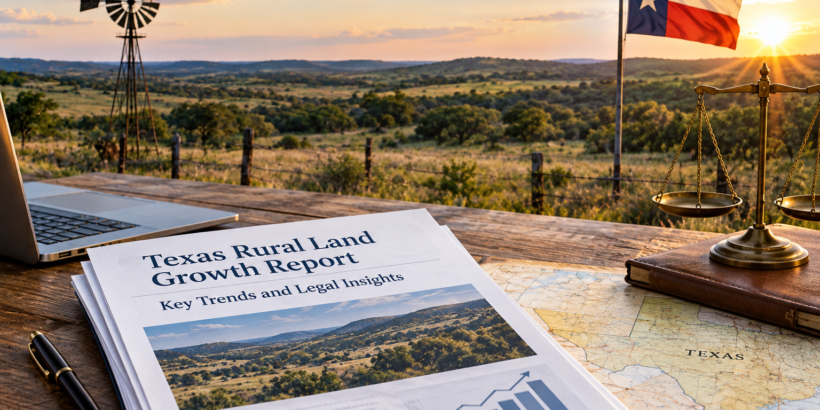
Drive an hour past any major Texas metro and you can watch the map change in real time. Pastures that carried cattle for three generations now sit behind new entry gates, and county roads that used to see a handful of trucks a day are lined with survey stakes. Rural Texas is not shrinking, but it is being redrawn, and the people redrawing it are a mix of ranchers, families, remote workers, developers, and investors.
This Texas rural land growth report breaks down what is driving that shift, how the market is behaving in different regions, and, just as important, which legal issues catch buyers and sellers off guard. Price per acre gets all the attention. Meanwhile, the real money is often won or lost on things like agricultural tax valuation, severed mineral rights, groundwater access, and who controls development outside city limits.
If you own rural acreage, are thinking about buying some, or advise people who do, the sections below walk through the trends first and then the legal framework that shapes them.
Why Texas Rural Land Is Growing So Quickly
Texas has added residents at a pace few states can match for years, and housing in the big metros has not kept up with demand. The overflow goes outward. Counties that were firmly rural a decade ago now sit inside commuting range of Austin, Dallas–Fort Worth, Houston, and San Antonio. That pressure explains most of what we see on the ground, but it isn’t the whole story.
Population Pressure and the Suburban Spillover
When a metro’s affordable housing runs out, buyers start looking at five-acre and ten-acre tracts 40 or 60 miles from downtown. Developers follow, and so do utilities, retailers, and school districts. The Texas Demographic Center and census data show the pattern clearly: the fastest percentage growth tends to happen in the counties surrounding the big metros, not in the metros themselves.
For landowners at the edge of this wave, the effect shows up first in unsolicited offers. A letter from an out-of-state “land acquisition team” is usually the earliest sign that your acreage has moved onto someone’s growth map.
Remote Work, Lifestyle Buyers, and Land as a Hedge
A large share of today’s buyers don’t plan to farm at all. They want a weekend ranch, a place for horses, a hunting property, or a permanent home with room to breathe. Remote and hybrid work made that realistic for people who once needed to live near an office.
Land also appeals as a hard asset. Buyers who are wary of stock volatility or inflation often see acreage as something tangible that can be held, leased, improved, or passed down.
Investor and Developer Appetite
Smaller investors are buying raw acreage to hold and sell later, while larger developers assemble multiple parcels for master-planned communities, industrial sites, and energy or data infrastructure. Solar and wind leases, pipeline corridors, and transmission lines add another layer of demand in certain regions, especially West Texas and the Panhandle.
Texas Land Market Trends Worth Watching
Averages can mislead here. “Texas land prices” is a bit like “American weather”: technically a category, practically useless. What matters is how a specific county, parcel size, and use case behave. Still, several trends show up repeatedly in market research, including the long-running land market reports from the Texas A&M Real Estate Research Center.
Trends that keep appearing across regions:
- Smaller tracts move fastest. Parcels in the 5 to 50 acre range tend to attract the most buyers, because they fit lifestyle budgets and financing.
- Large ranches trade differently. Big, contiguous properties sell on productivity, water, and recreational value, and the buyer pool is smaller and better capitalized.
- Water is becoming a pricing factor. Properties with reliable groundwater, a pond, or river frontage command attention that dry tracts don’t.
- Access and utilities matter more than scenery. A pretty view with no legal road access is a problem, not an asset.
- Interest rates shape timing. Financing costs affect how quickly lifestyle buyers can act, which in turn affects days on market.
How Regions Compare
The state is too large to treat as one market. The table below summarizes how demand and legal concerns tend to differ by region.
| Region | Main Demand Drivers | Typical Buyer | Legal Issues to Watch |
|---|---|---|---|
| Hill Country | Lifestyle, recreation, proximity to Austin and San Antonio | Second-home buyers, families, small investors | Groundwater limits, subdivision rules, wildlife valuation |
| Panhandle and High Plains | Agriculture, wind and solar, grazing | Producers, energy developers | Lease terms, water rights, mineral ownership |
| East Texas (Piney Woods) | Timber, recreation, Houston and DFW spillover | Timber investors, hunters, retirees | Timber rights, easements, drainage |
| South Texas Brush Country | Hunting, ranching, oil and gas | Ranch buyers, hunting operators | Mineral severance, surface use agreements, wildlife management |
| Gulf Coast Prairies | Industrial growth, Houston expansion | Developers, investors | Flood risk, floodplain rules, ETJ issues |
| Blackland Prairie (DFW corridor) | Residential and commercial growth | Developers, builders | Annexation, rollback taxes, utility access |
If you’re comparing opportunities across regions, the “legal issues” column deserves as much of your attention as the price column.
Agricultural Valuation: The Tax Rule That Shapes Almost Every Rural Deal
Few topics change the economics of rural land as much as agricultural appraisal. Under Chapter 23 of the Texas Tax Code, qualifying land is taxed based on its productive capacity rather than its market value. Texans usually call it “1-d-1” or “ag valuation,” and the savings can be dramatic compared to being appraised at market value, especially in fast-appreciating areas.
The Texas Comptroller’s property tax resources explain the program’s basics, and your county appraisal district administers it locally. In practice, most landowners learn the details only after something goes wrong.
What It Takes to Qualify
In general, land must have been devoted principally to agricultural use for at least five of the preceding seven years, and the use must be to the degree of intensity generally accepted in the area. A few practical points:
- Intensity matters. Putting two cows on 100 acres rarely satisfies an appraisal district. Stocking rates vary by county, so ask your district what it expects.
- Documentation wins disputes. Keep receipts, grazing leases, hay sales, feed invoices, and photos with dates.
- Timing is strict. Applications generally must be filed with the appraisal district by the deadline, typically before May 1 of the tax year. Late filing options exist but cost extra.
- Changes in ownership can disrupt qualification. A new owner has to file a new application, and the history of use still matters.
Wildlife Management as a Qualifying Use
Many buyers who never planned to ranch use wildlife management to keep their valuation. Land already appraised as agricultural can qualify for wildlife management use if the owner carries out at least three of seven recognized practices: habitat control, erosion control, predator control, supplemental water, supplemental food, shelter, and census counts.
Texas Parks and Wildlife publishes guidelines by region, and appraisal districts often rely on a written wildlife management plan. The plan has to be real. Districts do audit these, and a thin plan with no evidence of follow-through is how people lose their valuation.
Rollback Taxes: The Cost of Changing Your Mind
Here is where buyers get surprised. If land leaves agricultural use because of a change in use, such as building a subdivision, starting a commercial operation, or putting up improvements that disqualify the acreage, the owner can owe back taxes for the preceding three years plus interest. The rules have been revised by the Legislature over time, so confirm the current rule with the statute and your appraisal district before you plan around it.
Two habits prevent most of the damage:
- Ask before you close. Find out whether the land currently has ag valuation and whether your intended use will end it.
- Price the rollback into the deal. If a buyer plans to develop, the potential liability belongs in the negotiation.
Mineral Rights and Surface Use: Who Owns What Under Your Land?
In Texas, surface ownership and mineral ownership can be separate, and often are. A family may have sold the minerals decades ago, or retained them while selling the surface. A buyer who assumes “my land” includes everything beneath it can be badly mistaken.
Under Texas law, the mineral estate is generally considered the dominant estate, meaning the mineral owner has the right to reasonably use the surface to explore for and produce minerals. The courts have balanced that with the accommodation doctrine, which can require a mineral developer to accommodate existing surface uses when reasonable alternatives exist. The doctrine has limits, though, and it won’t protect a landowner from every inconvenience.
Questions to settle before you buy or sell:
- Are the minerals included in the sale, partially reserved, or fully severed?
- Is there an existing oil and gas lease, and who holds it?
- Does a surface use agreement exist, or can one be negotiated?
- Are there pipeline easements, tank batteries, or roads already crossing the property?
The Texas General Land Office and the Railroad Commission of Texas publish records and guidance that help trace some of this, but a title review by a Texas real estate attorney is the safer path. Mineral ownership questions are rarely visible on the surface and often turn on old deeds with ambiguous wording.
Water Rights and Groundwater: The Resource That Decides What Your Land Can Become
Land with no dependable water is limited, whatever the listing says. Texas treats surface water and groundwater under different rules, and the details differ across the state.
Surface water, meaning rivers, streams, and lakes, is generally state-owned and allocated through permits. Groundwater is typically treated as belonging to the landowner, which Texas courts have recognized in cases like Edwards Aquifer Authority v. Day. But ownership doesn’t mean unlimited use. Groundwater conservation districts regulate production in many parts of the state, setting well spacing, permit requirements, and in some cases pumping limits.
The Texas Water Development Board maintains maps and information on aquifers and groundwater conservation districts, which is a good starting point for any rural purchase.
Practical Water Checks Before Closing
- Find the groundwater district that covers the property and read its rules on new wells and exempt wells.
- Ask for well records: depth, yield, age, and any water quality test results.
- Look at the neighbors. Heavy pumping nearby can affect your supply over time.
- Confirm the water supply for any planned development. Some subdivisions fail at this stage because the water just isn’t there.
If a deal depends on irrigation, livestock water, or a future residential build, treat water verification as a condition of closing and not a follow-up task.
Zoning, ETJ, and Subdivision Rules: Who Controls Development?
Many people assume rural Texas has no land-use rules. That’s partly true and partly a trap. Counties in Texas have much narrower authority than counties in most other states, and they generally cannot adopt zoning ordinances. But that doesn’t mean anything goes.
Several layers can still apply:
- City limits and extraterritorial jurisdiction (ETJ). Cities can exercise certain regulatory powers, especially over subdivisions, in the ETJ surrounding them. The size of the ETJ depends on the city’s population.
- County subdivision regulations. Counties have authority under the Local Government Code to regulate how land is divided, including requirements for roads, drainage, and water and sewer service in certain situations.
- Deed restrictions. Private covenants can limit what you build, how you use the land, or whether you can split it.
- Floodplain regulations. Properties in mapped flood zones face extra requirements for building and development.
Recent legislation has also changed how landowners can deal with ETJ boundaries. Senate Bill 2038, passed in 2023, created a process allowing certain landowners to petition to be removed from a city’s ETJ, and the law drew legal challenges and procedural questions. If you’re relying on it, get current advice before you act.
The “Wildcat Subdivision” Problem
Selling off small pieces of a larger tract without following county platting rules can create real trouble. Buyers may end up with lots that can’t get utilities, permits, or financing. Sellers risk enforcement and, in some cases, civil claims. If you plan to divide land, check with the county before listing a single lot.
Access, Easements, and Boundaries: The Quiet Deal-Breakers
A parcel that looks perfect on a map can still be legally landlocked. Access issues turn up more often than buyers expect, particularly on older inherited land that was split in informal ways.
Look closely at:
- Recorded access easements. Confirm that they exist, where they run, and who maintains the road.
- Implied easements. Texas recognizes easements by necessity and implied easements in some circumstances, but proving one can be expensive and slow.
- Utility easements. Electric, pipeline, and telecom easements can restrict building locations and fence lines.
- Boundary accuracy. Old fences are rarely true boundary lines. A current survey is the only reliable answer.
Fencing deserves its own mention. Texas has a body of law on fence responsibility and boundary disputes, and ranchers know that fence conflicts get personal quickly. A good survey and written agreements with neighbors reduce the odds of a long argument later.
A Practical Due Diligence Checklist for Rural Land Buyers
Here’s the order of operations I’d recommend for any serious rural purchase:
- Order a title commitment early and read the exceptions, not just the summary. Pay attention to mineral reservations, easements, and restrictive covenants.
- Commission a current boundary survey and compare it with the deed and the appraisal district map.
- Check tax status with the county appraisal district: ag valuation, wildlife management, exemptions, and any rollback exposure.
- Verify water through the groundwater conservation district, well records, and, if needed, a test.
- Confirm legal and physical access to the property, including road maintenance responsibilities.
- Review zoning and development limits: city ETJ, county subdivision rules, floodplain maps, and deed restrictions.
- Investigate mineral and surface agreements, including any existing leases or surface use agreements.
- Check existing leases, such as grazing, hunting, wind, solar, or farming leases, since they may transfer with the land.
- Evaluate environmental and land condition: soil, drainage, past use, and any contamination concerns.
- Have a Texas real estate attorney review the contract before the option or due diligence period ends.
Skipping one of these steps is rarely fatal. Skipping several is how people end up with land they can’t use.
Common Mistakes That Cost Landowners Money
A few patterns come up again and again:
- Assuming ag valuation transfers automatically. It doesn’t. New owners need to apply and show the use.
- Buying “all the minerals” on a handshake. Mineral language belongs in the contract and the deed, in precise terms.
- Relying on a seller’s description of the boundary. The fence is not the survey.
- Using a form contract for a complex property. Standard residential forms often don’t cover water, minerals, or lease assignments in rural settings.
- Ignoring seller financing risks. Contract-for-deed arrangements are regulated by the Texas Property Code, and both sides need to understand the rights and obligations involved.
- Waiting too long to involve a lawyer. Problems are cheapest to fix before closing.
Another quieter issue is foreign ownership. Texas passed legislation in 2025 restricting certain land purchases by entities connected to designated countries. If you’re buying, selling, or financing with international parties, confirm how the statute applies before signing.
What the Next Few Years Probably Look Like
Nobody can promise where prices will go, but the underlying forces look durable. Population growth continues to push development outward. Infrastructure projects, from highways to transmission lines, open new areas to buyers. Water scarcity will keep sharpening the legal and political fight over groundwater, particularly in fast-growing regions.
Expect more legislative changes, too. The Texas Legislature has been active on property tax relief, ETJ authority, and land ownership, and the full text of enacted laws is available at the Texas Statutes website. Rules that apply today may look different at the next session, so any long-term plan should account for that.
For landowners, the practical takeaway is straightforward. Land that is well documented, with clear title, defensible tax status, verified water, and clean access, will tend to hold its value and sell more easily. Land with unresolved questions will sell at a discount or not at all.
Conclusion: Make Your Next Land Decision With the Legal Picture in Front of You
Rural Texas offers real opportunity, and the pace of growth makes it easy to feel pressure to move quickly. The buyers and sellers who come out ahead tend to be the ones who slow down on exactly the points that look boring: tax status, mineral reservations, water, access, and local regulation.
If you want a deeper look at current patterns and how they connect to property law, read our full Texas rural land growth report, then use the checklist above to test your own situation against it.
And if you’re facing a specific purchase, sale, subdivision, or dispute, talk to a lawyer before the deadline starts running, not after. The attorneys at Texas Horizons Law Group work with landowners, buyers, and investors on exactly these issues, from title review and contract negotiation to mineral, water, and development questions. Reach out, describe your property, and get a clear read on your risks before you commit.
This article is for general information and isn’t legal advice. Laws and appraisal district practices change, and your facts matter, so consult a licensed Texas attorney about your situation.