
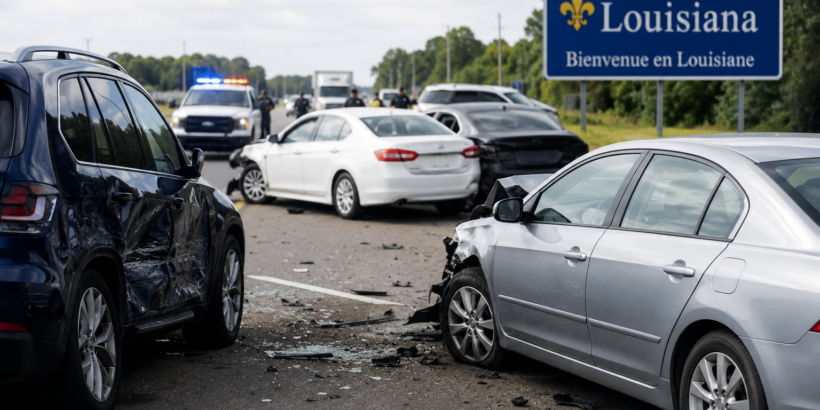
Multi-Vehicle Accident in Louisiana: Who Pays Damages?
Written and reviewed by Powellsss Editorial Team.
You’re stopped in traffic on I-49 when a pickup slams into the sedan behind you, shoving it into your rear bumper. Within seconds, two more vehicles pile in. Now four insurance companies are calling, every adjuster is pointing at a different driver, and nobody agrees about who owes what. This confusion is normal after a Louisiana pileup—and it’s exactly what the state’s fault-allocation system is built to sort out. This guide explains how Louisiana divides responsibility among multiple drivers, which policies pay first, what the current comparative fault and No Pay, No Play rules actually say, and which deadlines and evidence can make or break your claim.
Determining Fault in a Multi-Car Crash in Louisiana
In Louisiana, liability in a multi-car accident is divided among every driver whose negligence contributed to the crash. Fault is apportioned by percentage under Civil Code article 2323, and each at-fault driver’s insurer generally pays only that driver’s assigned share of your damages, up to policy limits — not the entire pileup.
That framework surprises people. No rule makes the first driver — or the last one — automatically responsible for every crushed fender and injured neck in the sequence. Louisiana’s general fault statutes, article 2315 and article 2316, require anyone whose negligence causes damage to repair it, but in a chain reaction the inquiry happens impact by impact. A judge or jury assigns each responsible person a percentage of fault, and those percentages must total 100%. Under article 2324, liability among multiple tortfeasors is joint and divisible, meaning one negligent driver ordinarily isn’t stuck paying another driver’s share.
Allocation can even reach people who aren’t in the courtroom. Article 2323 requires the fact-finder to weigh the fault of all persons who caused or contributed to the loss, including non-parties — a driver who fled the scene, for instance, or one who settled before trial. And drivers aren’t always the only responsible parties. When a commercial vehicle is involved, article 2320 can make an employer answerable for an employee acting within the scope of employment; when a vehicle or roadway defect contributes, article 2317.1 imposes its own proof requirements. Neither creates automatic liability.
A few practical consequences follow:
- The police report matters, but it doesn’t conclusively decide legal fault. It’s evidence an insurer, judge, or jury weighs alongside photographs, vehicle damage, and witness accounts.
- Three or more drivers can each carry a slice of responsibility — 60/25/15 splits are common in pileup litigation.
- Because payment follows percentages, the question of who pays damages in a multi-car accident rarely has a one-word answer.
Expect each insurer to defend its own policyholder’s percentage aggressively. When five drivers give five different accounts of the same ten seconds, fault allocation becomes the central battleground of the claim — long before anyone argues about the dollar value of your injuries.
Impact-by-Impact Fault: Chain Reactions and Middle Vehicles
Picture a four-car chain reaction on a foggy stretch of I-10. Car A stops for traffic. Car B brakes in time. Car C doesn’t, striking B and pushing it into A. Car D, following too closely, then hits C. Who pays for what? Louisiana answers that question impact by impact, not by picking a single villain for the whole event.
The starting point is causation: each driver answers for the damage their negligence actually caused. Article 2324 reinforces this by making each tortfeasor responsible for their assigned share rather than the entire loss. So the driver who triggered the sequence may owe for the first two impacts but not necessarily the fourth — if Car D’s driver had room and time to stop and simply wasn’t paying attention, that’s a separate negligent act with its own percentage.
| Crash scenario | How fault is typically analyzed | Who may bear responsibility |
|---|---|---|
| Initial (lead) collision | The driver whose negligence triggered the sequence answers for the damage that impact caused | The initiating driver, up to policy limits |
| Secondary or follow-on impacts | Each trailing driver is judged on speed, following distance, and braking response | Trailing drivers carry their own percentages for the impacts they caused |
| Stopped middle vehicle pushed forward | The following-motorist presumption generally protects a driver struck from behind and shoved into the car ahead | The driver who struck the middle vehicle |
| Independent negligence | Distinct careless acts — distraction, speeding, delayed braking — are evaluated separately | Each negligent driver, apportioned under articles 2323 and 2324 |
This is why pileup crash fault in Louisiana so often produces split verdicts. Two people can honestly describe the same crash and both be partly right.
Pushed-Through Vehicles and the Following-Motorist Presumption
Louisiana courts presume that a motorist who rear-ends a stopped or slowing vehicle was negligent, though the presumption can be rebutted. In Ebarb v. Matlock, the Second Circuit applied that presumption in a three-vehicle collision where the stopped middle car was pushed into the lead vehicle — and the middle driver escaped liability for the forward impact. If you were the middle car, that line of cases is your shield.
Secondary Collisions and Independent Driver Negligence
The presumption cuts the other way for trailing drivers. Following too closely, speeding for conditions, or braking late can each support an independent fault allocation for the impacts that driver caused — even when an earlier collision set the events in motion. In practice, insurers reconstruct each impact separately, which is why one pileup can generate several distinct liability disputes rather than a single claim.
Louisiana Comparative Fault Law and the 51% Recovery Bar
Louisiana comparative fault law changed in a way every crash victim needs to understand before valuing a claim. Under 2025 Act 15, which took effect January 1, 2026, the current version of article 2323 bars recovery entirely for any claimant found more than 50% at fault. Claimants assigned 50% or less still recover — but their damages shrink in proportion to their share of fault.
The math is stark. If your damages total $100,000 and you’re 30% at fault, you recover $70,000. At 50% fault, you recover $50,000. At 51% fault, you recover nothing — not a reduced award, nothing. That single percentage point is the difference between a substantial recovery and a closed file, which is why fault percentages in a Louisiana personal injury claim are litigated so hard.
One caution matters enormously here: the 51% bar applies to claims governed by current law. If your crash happened before the Act’s effective date, a different version of the comparative fault statute may control, and applying today’s language retroactively would be a mistake. The accident date drives which rules apply, so older crashes need date-specific analysis before anyone quotes a threshold.
Also remember that allocation reaches beyond the drivers in the room. Because article 2323 counts the fault of all contributing persons — including non-parties — a defendant can argue that an absent driver, an employer, or even you carry part of the percentage. Every point shifted onto your side of the ledger reduces (or, past the line, eliminates) your Louisiana car accident compensation. Those are the real stakes behind every recorded statement and every accident reconstruction.
Navigating Multiple Insurance Policies and Exhausted Limits
Legal fault and the first check you cash are two different things. The insurer that pays you first — often your own — may not belong to the driver ultimately responsible, and sorting that out is the practical heart of a multi vehicle collision insurance payout.
Start with the problem of scale. Louisiana’s minimum liability limits under La. R.S. 32:900 are $15,000 for bodily injury to one person, $30,000 for all injured people in one accident, and $25,000 for property damage. In a five-car pileup with three injured drivers, that $30,000 per-accident cap gets divided among competing claimants with hospital bills of their own. Minimum limits are a floor, not a promise of what anyone actually receives.
So where does money come from while fault is contested? Several coverages can pay in parallel:
- Your collision coverage repairs or totals your vehicle regardless of fault, minus your deductible.
- MedPay covers medical expenses up to its limit without waiting for a fault ruling.
- The at-fault drivers’ liability policies pay their insureds’ assigned shares, subject to limits.
- Your UM/UIM coverage steps in when the responsible drivers have no insurance or not enough.
After your insurer pays, subrogation begins: it pursues the at-fault drivers’ carriers for reimbursement, and per LDI consumer guidance, that recovery effort can include your deductible. You don’t have to wait for three adjusters to finish arguing before your car gets fixed.
First-Party Coverages: Collision and MedPay
Using your own collision coverage is often the fastest route to repairs while liability remains disputed — you pay the deductible, your insurer pays the rest, and subrogation sorts out final responsibility later. MedPay works similarly for early medical bills, paying covered expenses regardless of fault up to the policy limit. Both coverages exist precisely for the gap between the crash date and a final fault allocation.
Uninsured/Underinsured Motorist (UM/UIM) Claims
Under La. R.S. 22:1295, UM/UIM bodily-injury coverage exists unless the named insured validly rejected it, chose lower limits, or made another permitted election — so your declarations page and any signed election forms matter. When one tortfeasor’s per-accident limit is exhausted across several injured claimants, a UIM claim against your own policy can cover the shortfall between their limits and your proven damages.
Louisiana’s Updated “No Pay, No Play” Law (La. R.S. 32:866)
If you were driving uninsured when the crash happened, Louisiana’s No Pay, No Play statute can slash your recovery even when the other drivers were entirely at fault. Under the current version of La. R.S. 32:866, an uninsured owner or operator cannot recover the first $100,000 of bodily-injury damages or the first $100,000 of property-damage damages.
Those figures matter because much of what’s written online is stale. Older articles still cite the former $15,000 and $25,000 thresholds; the 2025 amendments raised both to $100,000. If you’re researching your own crash, check the date on anything you read.
The restriction targets the uninsured vehicle’s owner and operator, and it applies regardless of how blameless they were in the pileup. Fault and the recovery bar operate independently: the other drivers’ percentages decide what your claim is worth, and No Pay, No Play decides how much of that value you’re allowed to collect.
The statute is harsher than its nickname suggests but not absolute. Its exceptions include crashes where the other driver acted intentionally, fled the scene, or was engaged in certain criminal conduct, and situations where your uninsured vehicle was legally parked when struck. There’s also an important passenger protection: a passenger injured in an uninsured vehicle generally keeps the right to pursue a negligent driver — unless that passenger also owns the uninsured car.
For multi-car crashes, the statute creates a trap worth flagging. An uninsured driver might have a strong liability case against two negligent motorists and still walk away with nothing on the first $100,000 of injury damages. Carrying at least the minimum required coverage isn’t just a legal obligation; in Louisiana it’s the price of admission to a full personal injury claim.
Resolving Vehicle Repairs, Rental Cars, and Total Losses
Property damage sounds simpler than injury claims, but in a pileup it generates its own fights: which shop, which insurer, how much for the car, and who pays for the rental while everyone argues.
Louisiana’s claims-handling statute, La. R.S. 22:1892, sets the ground rules. For first-party claims, payment of an amount due generally follows satisfactory proof of loss; for third-party property-damage claims, the payment clock typically runs from a written settlement agreement. Insurers must also begin adjusting a loss within a set period after notification. If an insurer requires a proof-of-loss form, La. R.S. 22:1892.3 obliges it to supply the form promptly and tell you whether your submission is complete or deficient — so respond to documentation requests quickly and in writing.
On rentals and loss of use, the statute addresses reasonable alternative transportation when a third-party claimant’s personal vehicle sits unavailable for more than five business days because of insurer inaction, and it covers first-party rental benefits after a written request when the policy provides them. The LDI’s after-accident guide adds two practical points: you may choose your own repair facility, and when your insurer pays first, it can pursue the at-fault carrier — including recovery of your deductible.
If the car is totaled, the insurer doesn’t simply pick a number. Article 22:1892 contemplates valuation through market surveys, recognized vehicle-valuation sources with supporting documentation, qualified experts, and local-market evidence in specified circumstances. Ask which method was used and request the underlying comparables; a total-loss offer is a starting point for verification, not a verdict you must accept.
Evidence Preservation, Medical Causation, and Critical Deadlines
Chain-reaction cases are won on evidence gathered in the first days, because every driver has an incentive to remember the sequence differently. Louisiana law also imposes duties and deadlines that start running immediately.
After any multi vehicle accident in Louisiana, work through this checklist:
- Report the crash. La. R.S. 32:398 requires immediate notice to local police, the sheriff, or state police — depending on location — for crashes involving injury, death, or apparent property damage of $500 or more.
- Photograph everything. Vehicle resting positions, each point of impact, debris fields, skid marks, and visible injuries. Impact patterns often reconstruct the sequence better than memories.
- Collect witnesses independently. Get names and numbers of drivers, passengers, and bystanders — don’t rely on the police report to capture everyone.
- Preserve electronic evidence. Dashcam files, nearby traffic or business cameras, and event data recorder information can vanish quickly; send preservation requests early and avoid repairing or disposing of your vehicle before it’s documented.
- Get medical care and keep the records. Treatment chronology ties injuries to the crash.
On the medical side, two current rules shape what your claim is worth. Under La. R.S. 9:2800.27, recoverable past medical expenses for treatment paid by a health insurer or Medicare to a contracted provider are generally limited to amounts actually paid plus your cost-sharing — not the larger billed charges. And under La. Code Evid. art. 306.1, having no prior condition doesn’t create a presumption that the crash caused your current one; causation still must be proven with records and testimony.
Finally, deadlines. For qualifying delictual actions arising after July 1, 2024, 2024 Act 423 provides a two-year liberative prescription period running from the day the injury or damage is sustained. That’s the lawsuit-filing clock — separate from insurer claim-handling timelines, crash-reporting duties, and any tolling rules for minors or older accidents. Miss it, and even a perfectly documented claim dies.
Protecting Your Rights After a Louisiana Multi-Car Crash
Three key takeaways carry the most weight. First, fault in a Louisiana pileup is allocated impact by impact and driver by driver — no one automatically pays for everything, and your own percentage can reduce or, at 51% or more, erase your recovery. Second, the first insurer to pay is rarely the last word; collision, MedPay, UM/UIM, and subrogation exist to bridge the gap while liability is sorted. Third, evidence and deadlines decide outcomes long before negotiations do.
When the other drivers dispute the sequence, adjusters start assigning you percentages, or policy limits are stretched across several injured people, a legal evaluation stops being optional. Consulting an experienced Louisiana personal injury firm — Rice & Kendig, a Shreveport practice handling motor vehicle and catastrophic injury claims, is one example — can help you assess fault shares, coverage layers, and filing deadlines before they harden against you.
This article provides general legal information, not legal advice. Laws and procedures vary by jurisdiction; consult a licensed attorney about your specific situation.