
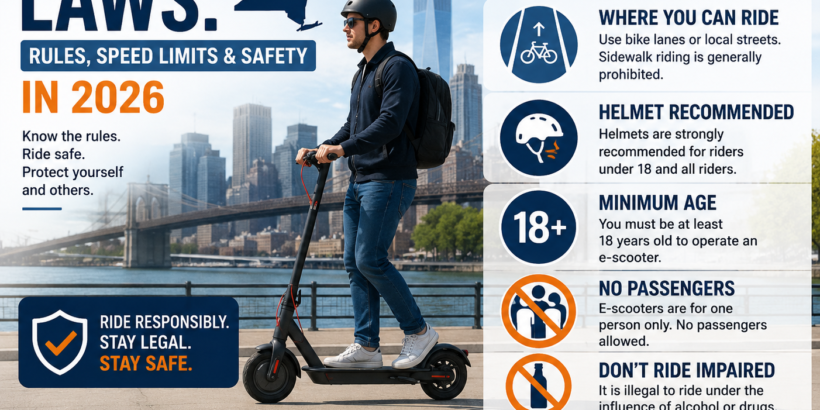
NY E-Scooter Laws: Rules, Speed Limits & Safety in 2026
Written and reviewed by Powellsss Editorial Team.
A commuter steps off the subway in Long Island City, unlocks a rental scooter, and rolls toward the bike lane on Vernon Boulevard — past a delivery rider doing twice her speed on the sidewalk, past a teenager on a seated scooter with no helmet, past a shared e-scooter parked neatly at the curb. Three of those four scenes involve someone breaking at least one New York rule, and most riders couldn’t tell you which.
That’s the real problem with electric scooter rules in New York: the law is layered. A statewide statute sets the baseline, New York City adds its own traffic rules and park policies, and individual towns and villages can add more on top. Whether you’re a daily commuter, a weekend rider, or someone who was just hurt in a scooter crash, this guide walks through what the law actually says — where you can ride, how fast, what gear you need, and what to do if something goes wrong. Everything here reflects research current as of August 14, 2026.
Quick Answer: Are E-Scooters Legal in New York?
Yes. Compliant e-scooters — devices under 100 pounds with a maximum motor-only capability of 20 mph — are legal in New York. Riders must be at least 16, may not exceed 15 mph while operating, may ride on roads posted at 30 mph or less and in bike lanes, and may not ride on sidewalks. New York City adds its own rules on top.
That short answer hides two things worth understanding before you ride. First, the device itself has to qualify. Under VTL §114-e, an “electric scooter” is a device weighing less than 100 pounds, with handlebars and a floorboard or seat, powered by an electric motor and/or human power, and capable of no more than 20 mph on a paved level surface when powered solely by the motor. If your device is heavier or faster than that, it may not be an “e-scooter” under the law at all — and a different, stricter set of rules may apply.
Second, the operating rules live in VTL Article 34-D, which covers everything from where you can ride to what happens after a crash. But Article 34-D expressly allows local governments to layer on their own requirements, which is why the answer for a rider in Buffalo may differ in details from the answer for a rider in Brooklyn.
So the honest version of “are e-scooters legal in New York?” is: yes, if the device fits the statutory definition, and if you follow both the state baseline and whatever your city, town, or village has added. The rest of this guide breaks down each layer.
New York State Law vs. NYC Rules: What’s Different
Think of New York’s framework as two stacked rulebooks. The bottom layer is VTL Article 34-D, which applies everywhere in the state: the 15-mph operating limit, the minimum age of 16, the sidewalk-riding prohibition, equipment requirements, and crash-reporting duties. For a plain-language overview of how these statewide rules fit together, see e-scooter laws in New York, while the statutory text itself remains the controlling source.
The top layer is local. VTL §1281 authorizes cities, towns, and villages to further regulate the time, place, and manner of e-scooter operation — including speed, protective headgear, reflective clothing, and designated or prohibited areas. New York City has used that authority in three notable ways:
- A codified 15-mph speed limit. NYC Traffic Rule §4-06 sets the NYC e-scooter speed limit at 15 mph, in a rule amended September 24, 2025 and effective October 24, 2025. Riders must also obey any lower posted limits.
- A Parks variance. NYC Parks currently allows e-scooters on park drives and NYC greenways under a variance running through December 31, 2026 — but not on park paths or sidewalks.
- A shared-scooter program. Bird, Lime, and Veo operate rental scooters in the East Bronx and Eastern Queens, with their own age and zone rules.
Here’s how the two layers compare on the questions riders ask most:
| Rule | New York State (VTL baseline) | New York City |
|---|---|---|
| Operating speed limit | 15 mph (VTL §1282) | 15 mph (Traffic Rule §4-06, eff. 10/24/2025) |
| Helmet | Required for operators ages 16–17 (VTL §1286) | Same state rule; NYC DOT recommends helmets for all riders |
| Minimum riding age | 16 (VTL §1282) | 16 |
| Sidewalk riding | Prohibited unless local law authorizes it | Prohibited per NYC DOT guidance |
| Park drives/greenways | No statewide authorization | Allowed under Parks variance through 12/31/2026 |
| Shared-scooter rental age | N/A (state law doesn’t set one) | 18+ under the city program |
One caution: state and city rules don’t really “conflict” — the city rule operates within the space the state statute leaves open. But other municipalities can and do write their own versions. Before you assume the rules you read about NYC apply in Yonkers, Albany, or a Long Island village, check the local code and posted signs.
Where You Can (and Can’t) Ride an E-Scooter in NYC
This is the question that brings most people here, so let’s make it practical. Under VTL §1282, e-scooters may operate on highways posted at 30 mph or less, on certain private roads open to public motor-vehicle traffic, and in designated bicycle or in-line-skate lanes — except where local law provides otherwise. A road posted at 35 or 40 mph is off-limits, full stop.
Within those roads, positioning matters. VTL §1284 directs riders to use a usable bike lane when one exists; if there isn’t one, ride near the right-hand curb or edge of the roadway, travel single file, and stop before entering a roadway from a private road, driveway, alley, or curb. Riders must also yield the right of way to pedestrians.
Sidewalks are simpler: don’t ride on them. State law prohibits sidewalk riding unless a locality affirmatively authorizes it, and NYC DOT instructs riders to stay off sidewalks entirely. One nuance trips people up: state law contains a narrow parking exception — a personally owned e-scooter may be parked on a sidewalk if it doesn’t interfere with pedestrian passage and the local jurisdiction provides an identification method. That’s permission to park, not to ride. Rolling even a few feet along the sidewalk to reach a rack is still riding.
Parks are their own puzzle. Under the current NYC Parks variance, e-scooters may use park drives and NYC greenways through December 31, 2026 — subject to segment-specific signs. The variance document separately flags the Hudson River Greenway south of 59th Street as subject to a state-law prohibition, so watch for posted restrictions there. Park paths and park sidewalks are not authorized, variance or no variance.
When you’re standing at a corner deciding whether a route is legal, run this checklist in order:
- Is there a usable bike lane? Take it.
- No bike lane — is the road posted at 30 mph or less? Ride near the right edge, single file.
- Is it a park drive or greenway covered by the current Parks variance? Allowed through 12/31/2026, subject to segment signs.
- Sidewalk or park path? No. Dismount and walk.
Shared and Rental Scooters in NYC
NYC’s shared e-scooter program operates in the East Bronx and Eastern Queens through three providers: Bird, Lime, and Veo. One detail surprises people: although state law lets 16- and 17-year-olds ride, the city’s shared program requires participants to be at least 18. So a 17-year-old can legally ride a personally owned scooter on a permitted street but can’t create a rental account. Provider terms and operating zones can change, so check the app’s current service map before planning a trip.
Speed Limits, Age, and Helmet Rules
The most common point of confusion in electric scooter rules in New York is the “20 mph versus 15 mph” question, and it’s actually two different numbers doing two different jobs. Twenty mph is the definition ceiling — the maximum motor-only speed a device can have and still count as an e-scooter under VTL §114-e. Fifteen mph is the operating limit — the fastest you may lawfully ride under VTL §1282. A scooter can be capable of 20 mph and legal to own, but riding it at 18 mph on a Queens street is a violation.
The New York electric scooter age requirement is 16. A person under 16 may not operate an e-scooter or ride as a passenger on one, and an adult may not knowingly allow a child under 16 to operate or ride. That last clause matters for parents: handing your 14-year-old the scooter for a spin around the block is itself prohibited.
New York’s electric scooter helmet laws are narrower than many guides suggest. Statewide, VTL §1286 requires a properly fitting helmet for operators ages 16 and 17 — not for all riders under 18, and not for adults. NYC DOT recommends that every rider wear a helmet regardless of age, and local governments can impose broader headgear requirements under VTL §1281, so the rule in your town may be stricter than the state floor. Given how unforgiving pavement is at 15 mph, a helmet is cheap insurance whatever the statute says.
Two more operating rules round out this section. Only one person may ride an e-scooter — carrying a passenger is prohibited, and riding as a passenger is too. And VTL §1289 separately prohibits operating an e-scooter while impaired by alcohol or drugs. If you’ve been drinking, the scooter is not the legal loophole some riders imagine it to be.
Equipment, Registration, and Battery Safety Requirements
Here’s some good news for owners: a VTL-compliant e-scooter requires no driver’s license, no license plate, no VIN, and no DMV registration. NYC DOT’s current vehicle chart confirms this for the statutory e-scooter category, which tracks with VTL §125‘s definition of “motor vehicle” excluding these devices. The caveat is the classification question — if your device doesn’t fit §114-e, registration rules may change entirely.
Night riding carries specific equipment duties under VTL §1285. From dusk to dawn, your scooter must have:
- A front white lamp visible from at least 500 feet
- A red rear light visible from at least 300 feet
- At least one light visible from each side for 200 feet
At all times, the scooter needs a bell or other audible signal capable of being heard from at least 100 feet (a siren or whistle doesn’t count) and a brake capable of controlling and stopping the device. If your scooter came with a weak buzzer and decorative LEDs, an upgrade is worth the few dollars.
There’s also a labeling rule. For scooters sold after June 1, 2022, sellers must affix a label stating the maximum motor-assisted speed, the persons for whom the scooter is designed or equipped, and the motor wattage. Operating on a public highway without that label can bring a civil fine of up to $50, though the statute provides a proof-based waiver mechanism in some cases. Before your first ride, find the label — it’s your quickest compliance check.
Battery safety belongs in this conversation, but with an important distinction. NYC requires covered micromobility devices to meet certification standards — UL 2272 for the powered device and UL 2271 for the storage battery — under rules enforced by the NYC Department of Consumer and Worker Protection. Those are obligations on sellers, not riders. Your side of the bargain is sensible charging and storage: use the manufacturer’s charger, don’t charge unattended overnight, and keep batteries away from exits and extreme heat.
Is Your Scooter Actually a Legal E-Scooter?
Before any of the rules above apply, your device has to pass the §114-e test: under 100 pounds, handlebars, a floorboard or seat, and no more than 20 mph of motor-only capability on a paved level surface. Plenty of devices sold online as “electric scooters” fail at least one prong — especially the speed one.
Are high-speed electric scooters legal in New York? Not as e-scooters. A device capable of 30 or 40 mph on motor power alone falls outside the statutory definition, which means it may be treated under moped or motor-vehicle frameworks with registration, licensing, and insurance requirements — or it may have no lawful on-road classification at all. The 2023 trial-level decision in Shah v. MVAIC illustrates the point: the court addressed a much faster scooter as sitting outside the ordinary statutory e-scooter definition. That decision is fact-specific and trial-level, not a universal rule, but it’s a warning about assuming every two-wheeled electric device gets e-scooter treatment.
Your pre-ride check is simple. Find the manufacturer label and confirm three data points: maximum motor-assisted speed (20 mph or less), intended riders, and motor wattage. Check the weight if the scooter is a heavy seated model. If the specs exceed the definition, the commuter-friendly rules in this article don’t apply to that device — and riding it on public roads could carry consequences far beyond a traffic ticket.
E-Scooter Accidents in New York: Reporting, Insurance, and Liability
Even a careful rider can end up in a crash — a dooring, a turning van, a pothole, a defective battery. What you do in the minutes and weeks after matters legally, so let’s walk through it.
At the scene. Stop. An operator age 18 or older who knows or has reason to know the operation caused physical injury must stop, provide identifying information when practicable, and report as required — and leaving a serious-injury crash is separately criminalized under VTL §§1287 and 1288. Get medical attention first if you need it, then document: photographs of the scene, vehicle positions, and your injuries; witness names and contact details; the driver’s plate and insurance information if a car was involved; and the police report number. If a rental scooter was involved, save the trip record from the app.
The reporting duty. Here’s where many online guides get it wrong. You’ll often read that any crash involving $1,000 or more in property damage must be reported to the DMV — that’s the general motor-vehicle rule, and importing it wholesale into e-scooter crashes is misleading. The e-scooter-specific provision, VTL §605(b), requires a written report to the Commissioner of Motor Vehicles within 10 days when another person is killed or suffers serious physical injury in a public-highway crash, subject to the statute’s incapacity provisions. “Serious physical injury” is a defined legal term, so whether a given crash triggers the duty is a fact question.
The liability decision tree. New York e-scooter insurance questions don’t have one answer — they branch by crash type:
- Struck by a car: A possible no-fault claim exists against the striking vehicle’s insurer. Under Insurance Law §§5102 and 5103, no-fault provides basic economic-loss benefits in covered motor-vehicle situations, and NY DFS guidance states that a pedestrian injured by a car generally claims against the striking vehicle’s insurer — with notice generally required within 30 days unless an exception applies. Whether a scooter rider qualifies depends on the collision, vehicle, policy, and claimant facts.
- Uninsured or hit-and-run driver: The Motor Vehicle Accident Indemnification Corporation (MVAIC) may provide a route for certain claims.
- Defective scooter or battery: A product-liability theory against the manufacturer, distributor, or seller may apply.
- Roadway defect: Claims against a city or other public corporation come with tight procedural deadlines — the alert below.
The 90-day alert. For many claims against a public corporation, General Municipal Law §50-e generally requires a notice of claim within 90 days, and §50-i sets a one-year-and-90-day period to commence the action after the statutory prerequisites. Miss the notice window and an otherwise strong roadway-defect claim can be lost before it starts. Treat this as a deadline alarm, not individualized advice.
Comparative negligence. New York follows CPLR §1411: a claimant’s culpable conduct generally doesn’t bar recovery but can reduce damages proportionately. Two e-scooter-specific provisions sharpen this. Under VTL §§1282 and 1286, failing to wear the required helmet or violating the passenger prohibition does not by itself constitute contributory negligence or assumption of risk, or bar or reduce a claim. Other facts — speed, lane position, yielding — can still affect fault allocation.
The 2025 decision in Munoz v. City of New York shows how fact-driven these cases are: an e-scooter rider in a bike lane, a turning van, and a dispute in which lane position, signals, speed, and witness accounts all mattered. One decision doesn’t predetermine yours, but it shows why documentation and early legal advice matter. If you’ve been hurt in a collision, a firm experienced in New York traffic-injury cases — for example, Fellows Hymowitz & Rice, a New York personal injury practice that handles motor vehicle and e-scooter accident matters — can evaluate which of these branches fits your facts. Every crash is different, and nothing here is a substitute for advice about your specific situation.
Conclusion: Ride Legally and Know Your Rights
Three things are worth carrying with you. First, classification comes before everything: a legal e-scooter is under 100 pounds and capped at 20 mph of motor-only capability, and devices outside that definition play by different rules. Second, the operating baseline is 15 mph, roads posted at 30 mph or less, bike lanes when usable, and never sidewalks — with riders 16 and up, helmets required at 16–17, and no passengers. Third, after a crash, the clock starts immediately: stop and exchange information, watch the 10-day serious-injury report, the 30-day no-fault notice, and the 90-day municipal notice of claim.
These rules are current as of August 14, 2026; local codes vary, and the NYC Parks variance expires December 31, 2026. Check VTL Article 34-D and NYC DOT for updates — and if you’ve received a citation or been injured, respond by the deadline on the ticket and speak with a qualified New York attorney before assuming the violation defines your case.
This article provides general legal information, not legal advice. Laws and procedures vary by jurisdiction; consult a licensed attorney about your specific situation.