
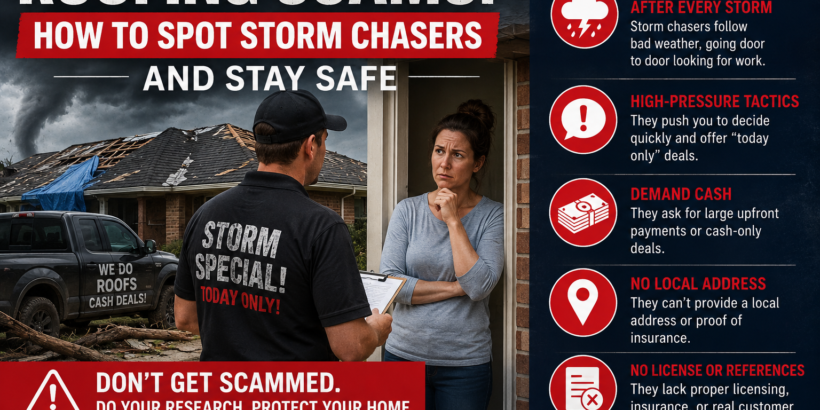
Roofing Scams: How to Spot Storm Chasers and Stay Safe
Written and reviewed by Powellsss Editorial Team.
The storm rolled through around midnight, and by eight the next morning there’s a pickup in your driveway. The man at your door says his crew is “already working in the neighborhood,” that he spotted hail damage from the sidewalk, and that your insurance will cover a full replacement — but only if you sign today. That moment, more than any other, is where roofing scams begin. The immediate rule: never sign, pay, or authorize permanent work during an unsolicited doorstep pitch. This guide lays out a verification-first framework, grounded in FTC and state insurance regulator guidance, for protecting your home, your claim, and your money — with state-law differences flagged where they matter most.
Storm Damage Hits — What to Do in the First Hour
After storm damage, never sign or pay at the door. Photograph the damage from a safe location, make only temporary emergency repairs such as tarping, save every receipt, and report the claim to your insurer before interviewing contractors.
That sequence matters because the hours immediately following roof storm damage are when homeowners are most vulnerable — and when fraudulent contractors exploit urgency. Here’s how to handle them.
Start with people, not property. Stay clear of downed power lines, unstable trees, and ceilings sagging under trapped water. Once the area is safe, document everything. Take wide shots and close-ups of damaged shingles, dented gutters, and fallen limbs from the ground or an upper window — never from a ladder on a wet roof. Then make only temporary repairs: a tarp over an opening, plywood over a broken window. Save the receipts, because reasonable mitigation costs are often part of an insurance claim. State regulators recommend exactly this approach and caution against extensive permanent repairs before the adjuster has assessed the loss, as outlined in California’s residential property claims guide.
Call your insurance company before hiring anyone. The NAIC recommends contacting your insurer first to open your claim, confirm policy coverage limits, and schedule an adjuster assessment before committing to repairs.
A simple “pause or act now?” test keeps the decision clean. Act now on anything involving active water intrusion, an exposed interior, or a safety hazard — but only with temporary mitigation. Pause on full replacement, contract signing, and deposits. None of those can be decided responsibly at your front door, and none of them need to be.
What Storm Chaser Roofers Are — and What They Aren’t
“Storm chaser roofers” is an informal label for contractors who travel to storm-hit markets to solicit repair work. The term is descriptive, not a conviction. Out-of-area and out-of-state contractors may be entirely legitimate, and the BBB notes that reputable roofers often work in storm-affected neighborhoods too. Geography tells you little; behavior, credentials, insurance, contract quality, and follow-up accountability tell you almost everything.
One distinction trips up many homeowners: a traveling insurance adjuster is not a traveling roofer. After large disasters, insurers legitimately bring in adjusters from other states to handle claim volume, per the NAIC’s post-disaster claims guide. An adjuster sent by your insurer is assessing your claim — you can verify them through your claim number. A storm chaser contractor knocking on your door is selling you a roof. Don’t confuse the two, and don’t let anyone blur the roles.
The clearest way to sort who’s who is to compare signals side by side:
| Signal | Legitimate Disaster-Response Roofer | Storm Chaser Scam Pattern |
|---|---|---|
| Arrival | You called them | Unsolicited door knocking |
| Payment | Milestone schedule | Cash-only or full upfront |
| Credentials | Verifiable license and COI | Vague or unverifiable |
| Contract | Detailed, written | Blank spaces, pressure |
| Insurance promises | Honest about coverage | “Guaranteed approval,” “free roof” |
| Local presence | Traceable address | Temporary or none |
| Follow-up | Warranty service | Disappears after payment |
One mismatched signal isn’t proof of fraud. A pattern across the right-hand column is a reason to walk away.
The Warning Signs of Roofing Scams
Recognizing contractor red flags allows you to halt high-pressure sales pitches before signing away your rights. The FTC’s home improvement scam guidance lists the most common warning signs of roofing scams, and they map closely to what regulators see after every major storm.
The approach itself. Unsolicited door knocking, “we’re already in the area,” and pressure to decide immediately are the classic opening moves. So are cash-only or full-upfront payment demands and requests that you pull the permits — a tell that the contractor may be unlicensed or trying to shift liability onto you. These door to door roofing scams rely on speed; anyone who won’t let you sleep on a decision has told you something important.
The credentials. Be skeptical of anyone claiming to be “FEMA-certified.” FEMA does not certify or endorse individual contractors, so the phrase itself is a credibility warning. The same goes for guaranteed insurance approval — no roofer can promise what your policy covers.
The money. “Free roof” offers usually mean the contractor expects insurance to pay for everything, sometimes by inflating the claim or quietly covering your deductible. Deductible waivers and price manipulation to absorb that cost can constitute insurance fraud, the NICB warns, and misrepresentation can jeopardize your own coverage. “Free inspections” deserve similar care: legitimate offers exist, but unsolicited inspections are a common entry point for exaggerated or even manufactured damage, along with surprise cost increases once work begins.
For a detailed breakdown of these tactics from a legal perspective — including deductible-waiver schemes, high-pressure contracts, and the remedies available when they cross the line — this guide explains how to protect yourself from storm chasers after a natural disaster.
How to Verify the Person, the Company, and the Paperwork
Verification turns a gut feeling into evidence. Whether you’re finding reputable local roofers or screening an unfamiliar crew, this seven-step workflow takes a day or two and filters out most bad actors.
- Verify the individual at the door. Call the company through a number you find independently — not the one printed on a business card someone hands you — and confirm the person on your porch actually works there.
- Note ID and vehicle details where lawful. A photo of a badge or license plate creates a record if problems emerge later.
- Check the license or local registration. State trade boards draw a key distinction: licensing requires passing competency exams, while basic registration merely records contact info. Note that states like Texas, Colorado, and Missouri do not license roofers at the state level, requiring verification through municipal or county building departments.
- Obtain and independently verify a certificate of insurance. A COI should show the insurer, policy number, and policy limits, including workers’ compensation coverage. California’s insurance department recommends calling the insurer directly to confirm the certificate is real and current — altered or expired certificates are a known problem.
- Confirm the business identity. A traceable physical address, local registration, and time operating under the same name all matter.
- Collect at least three written estimates. The FTC says each should identify the work, materials, completion date, price, and contractor contact information, so you can compare scope rather than headline price.
- Check references and reviews. Ask for recent local jobs you can drive past.
Once a candidate clears those steps, sit down with this ten-question interview script:
- Who owns the company, and how long has it operated under this name?
- Where is it registered, and what’s the license number?
- Who performs the work — employees or subcontractors?
- Who pulls the permits?
- What happens if the decking turns out to be damaged once the shingles come off?
- How are change orders priced and approved?
- What insurance do you carry, and can I verify the COI with your insurer?
- What warranties cover materials and workmanship?
- What does the payment schedule look like?
- When is final payment due?
A legitimate contractor answers these without flinching. Evasion on more than one or two is your answer.
Insurance Claims, Adjusters, and Insurance Claim Roof Fraud
Three distinct roles shape every storm claim, and insurance claim roof fraud often depends on blurring them. The insurer’s claims adjuster assesses damage and applies your policy. Your contractor estimates and performs repairs. A public adjuster is a licensed professional you hire to represent your side of the claim — their authority and licensing rules vary by state.
The boundary that matters: a contractor may inspect and estimate, but must not guarantee coverage, fabricate damage, or coach you into a false claim. The FTC is explicit that you should verify coverage with your insurer rather than relying on a contractor’s reading of your policy — and never sign an insurance check over to a contractor. Remember, too, that an estimate is not proof a claim will pay; that decision belongs to the insurer under your policy’s terms, deductible included.
Watch carefully for an assignment of benefits (AOB), which transfers policy rights and direct claim payouts to a third party. While historically common, states like Florida have banned residential property AOBs entirely (Florida SB 2-A), and other states strictly limit them, so consult state law before signing any transfer.
When you call your insurer, the NAIC suggests asking for your claim number, the filing deadline, a coverage overview, your deductible, any special procedures, and when the adjuster will visit. Then build a documentation kit and keep it current: before-and-after photos, the claim number, adjuster contacts, all estimates, the signed contract, every change order, the COI, invoices, canceled checks, lien releases, and written correspondence.
If a legitimate claim is denied, underpaid, or stalled, some policyholders consult attorneys who handle property-insurance disputes. The Omar Ochoa Law Firm, for example, represents Texas property owners in storm, roof, wind, hail, and hurricane damage claims and bad-faith insurer disputes. Legal help won’t be necessary for most claims — but knowing it exists changes your leverage when one goes wrong.
Contracts, Deposits, and Payments That Keep You in Control
A solid contract is your best defense against roof repair fraud. Per FTC guidance, it should include the contractor’s identity and license number where required, estimated start and completion dates, a detailed scope of work, the payment schedule, all promised terms, cancellation language where applicable — and no blank spaces anyone could fill in later.
The hidden-cost checklist is where contracts most often fail. Make sure yours addresses tear-off and disposal, decking contingencies, flashing, ventilation, gutters, permits, cleanup, exact material specifications, warranties, subcontractor use, change-order procedures, and lien releases from subcontractors and suppliers. On decking specifically: hidden rot may legitimately require replacement once shingles come off, as the NICB notes, but the pricing mechanism must be in the contract, with written change orders and supporting photographs — not a surprise invoice.
For payments, negotiate a reasonable down payment and recognize that some states cap deposits; there’s no national percentage, so check your state’s rules. Tie progress payments to completed milestones, pay by credit card or check to preserve a record, and avoid cash, wire transfers, gift cards, payment apps, and cryptocurrency. Release the final payment only after you’ve inspected the finished work and found it satisfactory.
Your Cancellation Rights and State-by-State Checks
The federal Cooling-Off Rule, codified at 16 CFR Part 429, covers certain personally solicited consumer sales made at your home when the price is $25 or more; the threshold rises to $130 for certain sales at temporary locations. For covered transactions, the seller must give you a dated contract plus two cancellation forms, you generally may cancel before midnight of the third business day, and the seller must refund your payments within 10 business days of valid notice.
The exceptions matter as much as the rule. Emergency transactions, visits you specifically requested for repair or maintenance, and sales made entirely by mail, phone, or online may fall outside the rule. So the common claim that “you always have three days” is a myth — a contract you signed at the contractor’s office, or after you called them for a repair visit, may not carry federal cancellation rights at all.
Everything else is state-by-state. Down-payment limits, licensing requirements, permits, AOB rules, deductible-waiver legality, and cancellation rights are not nationally uniform. Before signing, run the state-law handoff: check your state contractor licensing board, local building department, state department of insurance, attorney general, and consumer-protection office. USA.gov maintains a directory of state consumer-protection offices to get you started.
Already Signed or Paid? Your Recovery Path
If you’ve already signed a contract or handed over money, you still have options — act methodically rather than quickly. Preserve all evidence first: the contract, receipts, photos, texts, and emails. Stop further payments where appropriate, and if you believe the Cooling-Off Rule or a state equivalent applies, send your cancellation notice using the exact method the contract specifies and keep proof of delivery. Contact your card issuer or bank promptly, since payment protections vary, and notify your insurer — especially if the contractor has your claim number or an AOB. Then report the conduct to your state attorney general or consumer-protection office, your state insurance department, and the FTC, which tracks home repair scam patterns nationally. No one can promise a refund or automatic cancellation, but documented, prompt reporting is what makes recovery possible.
Keep this post-storm checklist close: don’t sign or pay at the door; document and mitigate temporarily; call your insurer first; get three written estimates; verify the person, license, and COI; sign a complete contract; pay by milestones; release final payment after inspection. The rule underneath all of it is simple: urgency at your door is a reason to slow down, not sign.